

Imagine trying to improve a team’s performance.
You begin analyzing communication problems, decision delays, and coordination issues. But quickly a question appears: What exactly counts as part of the system you are analyzing?
Is the system just the team itself?
Does it include leadership decisions?
What about external clients, partners, or other departments?
Without a clear answer, analysis becomes confusing.
Some problems seem internal. Others appear to come from outside. The situation becomes difficult to understand because the limits of the system are unclear.
This is where system boundaries become important.
Systems Layer
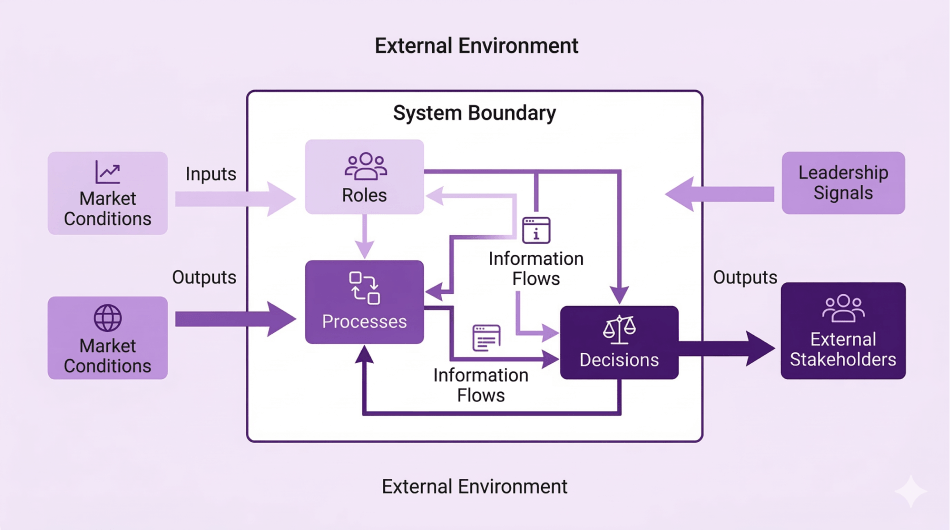
A system boundary defines what elements are included within a system and what elements exist in the surrounding environment.
Boundaries serve several structural functions:
- Defining system components — determining which actors, resources, and processes are part of the system
- Separating system from environment — distinguishing internal dynamics from external influences
- Regulating interactions — controlling how signals, resources, and decisions pass between inside and outside
- Clarifying analysis scope — determining what the system is responsible for and what lies beyond it
Within systems thinking, boundaries are not always physical. They are often analytical constructs that determine how a system is observed and understood.
Once boundaries are defined, interactions can be examined in terms of:
- internal relationships between system components
- external exchanges between the system and its environment
These interactions shape how the system receives inputs, processes them, and produces outcomes.
Structural Translation
In simple terms, boundaries answer a basic question:
What is part of the system, and what is not?
For example, when analyzing a team’s performance, the system might include:
- team members
- workflows
- decision processes
- communication channels
But leadership strategy or external market conditions might sit outside the system boundary, influencing it from the environment.
By defining this boundary, it becomes easier to see:
- which interactions happen inside the system
- which pressures come from outside
Without clear boundaries, analysis becomes blurred and difficult to interpret.
Structural Implication
When system boundaries are unclear, organizations often misdiagnose problems.
Common issues include:
- blaming internal teams for pressures originating outside the system
- overlooking external constraints affecting internal behavior
- attempting to solve environmental problems through internal adjustments
- failing to recognize how external signals shape internal decisions
Poor boundary definition can lead to interventions at the wrong level.
Effective system analysis requires clarity about where the system begins and ends, and how it interacts with the surrounding environment.
Leverage Insight
Boundaries determine what a system can control and what it must respond to.
By clearly defining system boundaries, Systems Language allows analysts and leaders to separate internal structure from environmental influence — a critical step in understanding how systems behave.
Pillar: Systems Language — perception.
