

In many environments, people assume that progress is mainly about removing obstacles.
If a team could move faster, if decisions could be made more freely, if resources were unlimited, then performance would improve.
Constraints are often seen as barriers — things that slow work down or prevent systems from reaching their potential.
Yet when constraints disappear entirely, systems can become unstable.
Without limits, growth may accelerate uncontrollably, decisions may conflict, and resources may be used inefficiently. In many cases, constraints are not simply restrictions.
They are part of what allows a system to function in a stable and predictable way.
Systems Layer
A constraint is a structural limit that shapes what actions are possible within a system.
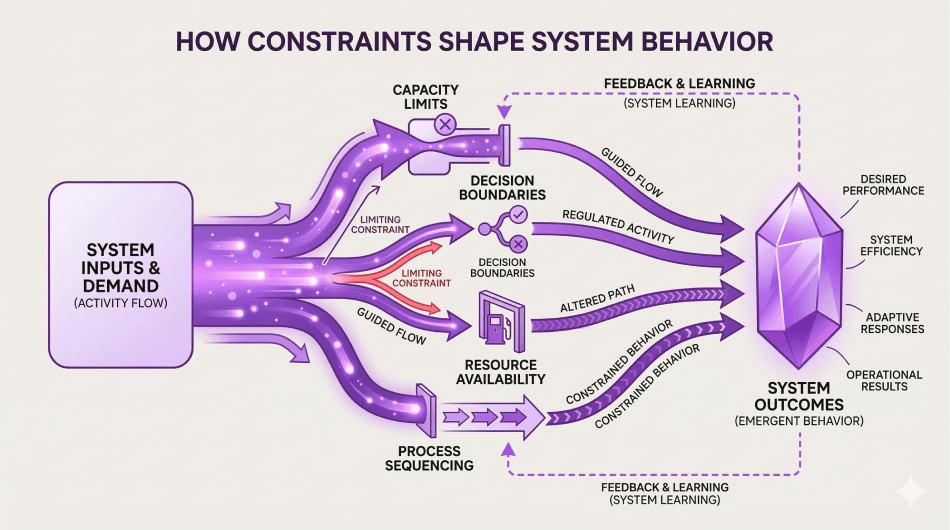
Constraints influence system behavior by defining:
- capacity limits — how much activity the system can sustain
- decision boundaries — what choices are permitted or restricted
- resource availability — how materials, time, or attention are distributed
- process sequencing — the order in which actions must occur
These limits create behavioral channels, guiding system activity into specific pathways.
In complex systems, constraints serve two major structural roles:
- Shaping behavior
Constraints influence how system participants adapt their actions. When certain paths are limited, people adjust their behavior to operate within the available options.
- Stabilizing dynamics
Constraints prevent reinforcing processes from expanding indefinitely. They introduce balancing forces that limit runaway growth, conflict, or resource depletion.
In this way, constraints often function as stabilizing structures within the system.
Structural Translation
In simple terms, constraints define how far a system can go and how it can move.
Imagine a river flowing through a valley.
The water represents activity within the system. The riverbanks act as constraints. They guide the flow, preventing the water from spreading randomly across the landscape.
Without those banks, the flow becomes unpredictable.
Similarly, in organizations or environments, constraints shape how work moves through the system.
They determine:
- how quickly things can happen
- where decisions are made
- how resources are allocated
The behavior of the system forms around these limits.
Structural Implication
When constraints are poorly understood, organizations often respond to problems by attempting to remove limits entirely.
Examples include:
- adding more tasks without increasing capacity
- expanding initiatives without coordination mechanisms
- removing decision boundaries without clarifying responsibility
These actions can unintentionally destabilize the system.
Alternatively, some constraints become overly restrictive, creating bottlenecks that slow the entire system.
Effective system design requires identifying which constraints stabilize the system and which constraints unnecessarily limit it.
Leverage Insight
Constraints are not simply barriers.
They are structural forces that shape system behavior.
Understanding how constraints guide activity allows systems to be designed with the right balance between flexibility and stability.
Pillar: Systems Language — perception.
