
In some organizations, everyone appears to be working hard, yet progress remains slow.
Teams push forward with projects. Managers set priorities. Processes are followed carefully. Despite the effort, outcomes still fall short of expectations.
People often interpret this situation as a problem of motivation, discipline, or communication.
But sometimes the deeper issue is not effort.
The system itself may be pulling in different directions.
Systems Layer
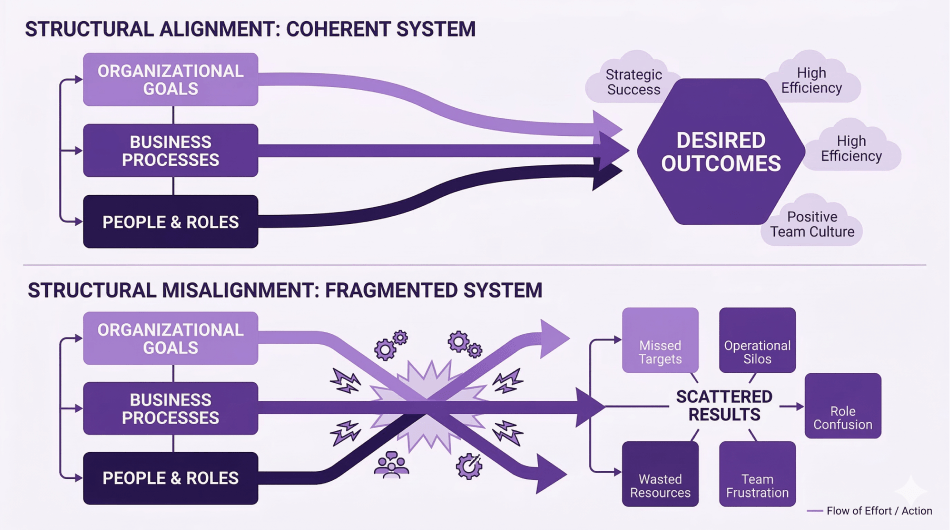
Structural misalignment occurs when key elements of a system are configured in ways that work against each other.
Three core structural elements must align for a system to function effectively:
- Goals — the outcomes the system is expected to produce
- Processes — the mechanisms used to produce those outcomes
- Roles — the actors responsible for carrying out those processes
When these elements are aligned, the system channels activity toward the intended results.
When they are misaligned, the system generates friction.
Examples of structural misalignment include:
- goals that require collaboration while processes reinforce silos
- roles responsible for outcomes without authority to make decisions
- performance metrics that reward behavior unrelated to the stated objective
- processes designed for stability while goals demand rapid adaptation
In such cases, the system sends conflicting structural signals.
Participants attempt to respond to these signals, but their actions pull the system in multiple directions.
Structural Translation
In simple terms, structural misalignment happens when the system design does not support the goal it is trying to achieve.
For example, an organization may aim to innovate quickly while still requiring multiple layers of approval for every decision.
Or a team may be responsible for delivering results while depending on another department that controls critical resources.
The individuals involved may be capable and motivated, but the system places them in positions where success becomes difficult.
Effort alone cannot overcome structural contradictions.
Structural Implication
When misalignment exists, organizations often respond by increasing pressure on individuals.
Typical responses include:
- asking teams to work harder
- introducing new policies or reporting requirements
- changing leadership roles
- emphasizing accountability
However, these actions rarely resolve the underlying issue.
If goals, processes, and roles remain misaligned, the system continues to generate friction regardless of who occupies the roles inside it.
Misalignment therefore produces persistent inefficiencies that cannot be solved through individual effort alone.
Leverage Insight
Alignment allows systems to channel effort toward outcomes.
Misalignment forces participants to navigate structural contradictions.
Systems Language helps reveal where goals, processes, and roles are pulling in different directions — creating opportunities to redesign the structure so the system can function coherently.
Pillar: Systems Language — perception.