
In many organizations, tasks appear to belong to separate teams.
One group handles planning. Another manages operations. A third oversees reporting or compliance.
At first glance, each part seems to operate independently.
But when something changes in one area, unexpected effects often appear elsewhere. A shift in priorities alters workload distribution. A delay in one process slows several others. A new policy influences how multiple teams coordinate their work.
These outcomes occur because systems are not made of isolated parts.
They are made of interdependencies.
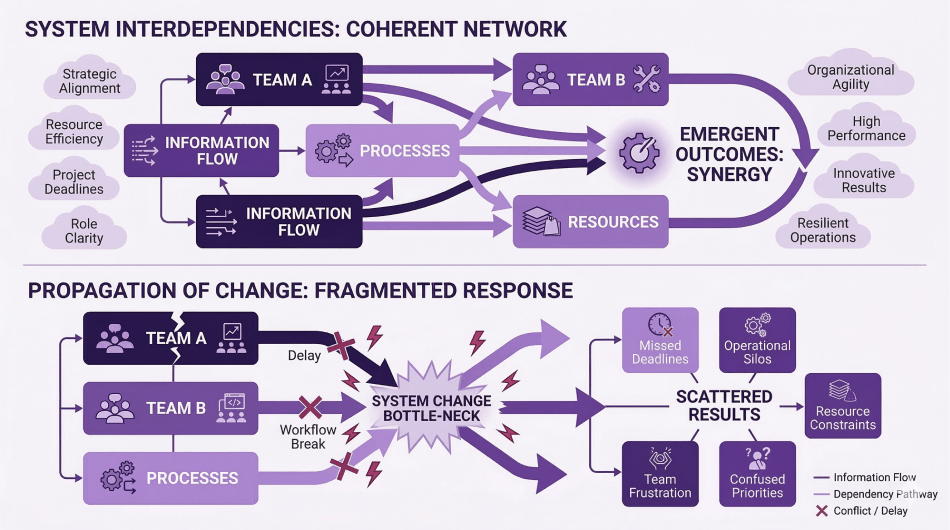
Systems Layer
An interdependency exists when the behavior or performance of one system component depends on the actions or outputs of another.
In complex systems, components rarely operate in isolation. Instead, they form networks of relationships involving:
- resource dependencies — components requiring materials, time, or support from others
- information dependencies — decisions relying on signals produced elsewhere in the system
- process dependencies — steps that must occur before other actions can begin
- decision dependencies — authority structures where choices in one area affect multiple others
These interdependencies create interaction pathways through which changes propagate.
When one component shifts its behavior, the effects travel along these pathways, influencing other components.
Through these interactions, systems generate emergent outcomes — results that arise from the collective behavior of interconnected elements rather than from any single component.
Structural Translation
In simple terms, interdependencies mean that parts of a system affect each other.
When one part changes, other parts adjust in response.
For example:
- if one team delays delivering information, other teams cannot proceed
- if a resource becomes scarce, multiple processes must reorganize
- if leadership changes priorities, several departments shift their activities
These effects spread through the system because the parts are connected.
The outcome that eventually appears is the product of many interactions happening together.
Structural Implication
When organizations overlook interdependencies, they often attempt to improve individual components in isolation.
Common responses include:
- optimizing one department without considering downstream effects
- introducing new processes without adjusting related workflows
- changing policies without accounting for coordination dependencies
These actions can unintentionally create new bottlenecks or inefficiencies elsewhere in the system.
Mapping interdependencies helps reveal how local changes propagate across the broader structure.
This allows interventions to be designed with awareness of the system as a whole.
Leverage Insight
Systems produce outcomes through networks of interdependent relationships.
By mapping these relationships, Systems Language makes it possible to anticipate how changes in one area will influence the rest of the system.
Understanding interdependencies is essential for managing complex environments.
Pillar: Systems Language — perception.