
In many organizations, problems appear obvious on the surface.
A project fails. A team struggles to coordinate. A strategy produces unexpected results.
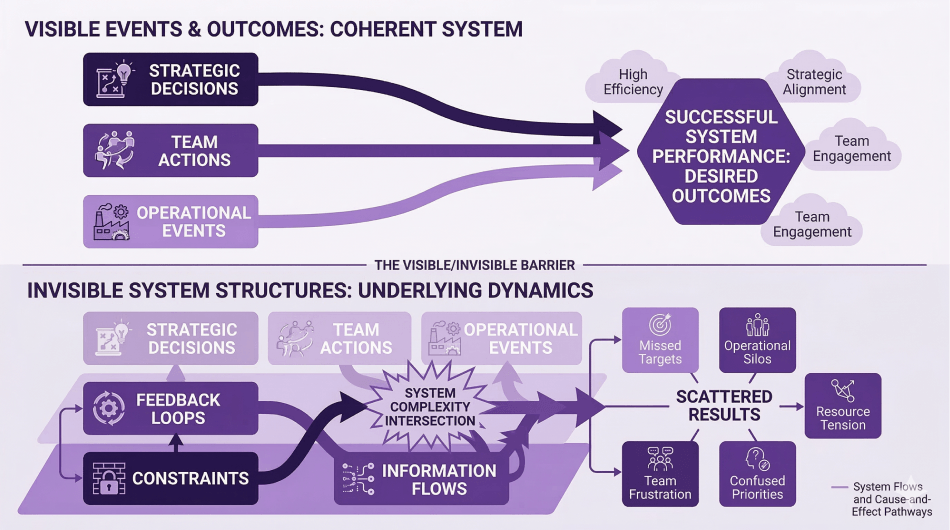
The visible explanation often focuses on what people can easily observe — decisions, actions, and events.
But beneath these visible outcomes are deeper system dynamics that are much harder to see.
Processes interact quietly in the background. Information flows through hidden channels. Constraints shape decisions long before actions become visible.
Because these structures operate beneath the surface, they are often misunderstood or overlooked entirely.
Systems Layer
Many important system structures are structurally invisible to participants inside the system.
This invisibility occurs for several reasons:
- Structural processes operate over time
Some system dynamics unfold gradually. Feedback loops, dependency chains, and constraint effects may take weeks or months to become visible as outcomes.
- Interactions are distributed
System behavior often emerges from multiple interactions occurring across different locations or teams. No single participant can easily observe the entire network.
- Structural signals are indirect
Participants typically experience system structures as pressures, delays, or limitations rather than as clearly visible mechanisms.
- Observation is event-focused
Human perception naturally focuses on events and actors rather than underlying arrangements or interaction patterns.
Because of these conditions, system structures frequently remain hidden even from those operating within them.
Structural Translation
In simple terms, the parts of a system that most strongly influence outcomes are often the hardest to see.
People notice:
- who made a decision
- what happened during a meeting
- which project succeeded or failed
But they may not notice:
- the information delays that shaped decisions
- the dependencies between teams
- the constraints limiting available options
- the feedback loops reinforcing certain behaviors
These elements quietly shape what becomes possible inside the system.
The visible event is only the final expression of deeper structural dynamics.
Structural Implication
When structures remain invisible, organizations often rely on incomplete explanations.
Common patterns include:
- attributing system outcomes to individuals rather than structural conditions
- solving symptoms rather than underlying causes
- repeating interventions that address visible events but not structural drivers
As a result, the same problems often recur.
Without structural visibility, organizations may spend significant effort responding to events without understanding the mechanisms producing them.
Leverage Insight
One of the primary purposes of Systems Language is to make invisible structures visible.
By mapping interactions, constraints, feedback loops, and dependencies, observers can reveal the underlying mechanisms shaping system behavior.
Once these structures are visible, meaningful system redesign becomes possible.
Pillar: Systems Language — perception.