
In many environments, actions seem disconnected from their outcomes.
A policy change is introduced, but its effects are unclear for months. A decision made today influences results long after the context has changed. A problem appears suddenly, even though its causes were set in motion long before.
Because the cause and the outcome are separated by time, it becomes difficult to understand what actually produced the result.
This is a common feature of complex systems: delayed consequences.
Systems Layer
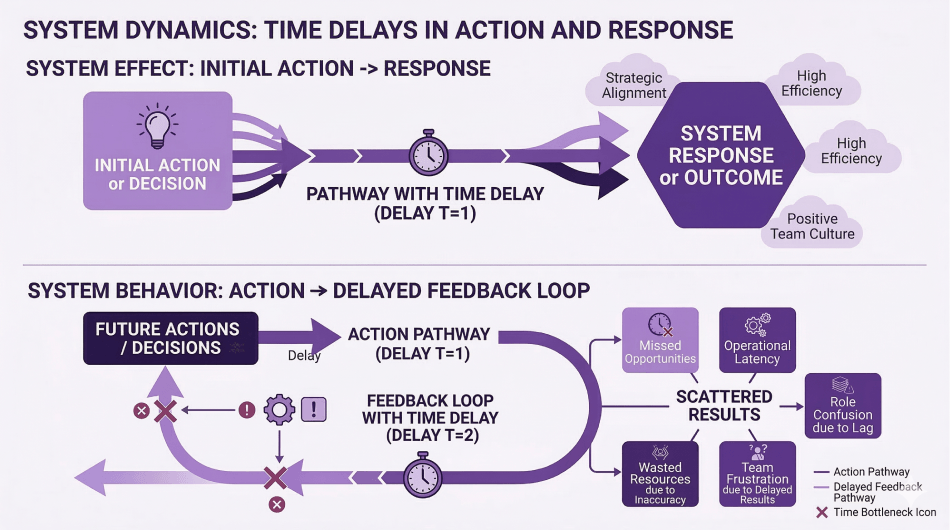
A time delay occurs when there is a gap between an action within the system and the observable effect that follows.
In complex systems, many interactions involve delays because processes take time to unfold.
Delays can occur in areas such as:
- information flow — signals traveling slowly between parts of the system
- decision implementation — policies or strategies taking time to influence behavior
- resource adjustments — hiring, training, or production changes requiring time to take effect
- feedback loops — system responses emerging only after a period of accumulation
These delays complicate system behavior because cause and effect are no longer immediately visible.
Participants may interpret outcomes based on recent events rather than the earlier actions that actually triggered the effect.
As a result, systems with delays can produce misleading signals about what is driving outcomes.
Structural Translation
In simple terms, delayed consequences mean that the results of a decision may appear long after the decision was made.
For example:
- a hiring decision today affects team capacity months later
- a change in pricing influences customer behavior gradually over time
- a process improvement may take several cycles before performance visibly improves
When delays are present, the system’s response is slower than the decisions affecting it.
This makes it difficult to connect actions with their results.
Structural Implication
When time delays are not recognized, decision-makers often misinterpret system feedback.
Common patterns include:
- reacting to short-term signals before earlier decisions have taken effect
- introducing new changes while previous changes are still unfolding
- attributing outcomes to the wrong causes because the true cause occurred earlier
These reactions can create cycles of overcorrection where the system is constantly being adjusted without allowing enough time for effects to appear.
Recognizing delays helps maintain stability by allowing time for the system to respond before additional interventions are introduced.
Leverage Insight
In systems with delays, understanding when effects will appear is as important as understanding what causes them.
Systems Language helps reveal the temporal relationships between actions and outcomes, improving the ability to interpret system feedback accurately.
Pillar: Systems Language — perception.