
It is common to assume that behavior is mainly a reflection of personality.
One person is proactive. Another is cautious. Some people communicate clearly while others struggle to coordinate with a team.
Yet something interesting often happens when people move between environments.
A person who seemed ineffective in one organization performs exceptionally well in another. A highly motivated team becomes slow and cautious after a structural change. Individuals who normally collaborate easily begin working in silos.
The people have not fundamentally changed.
The system around them has.
Systems Layer
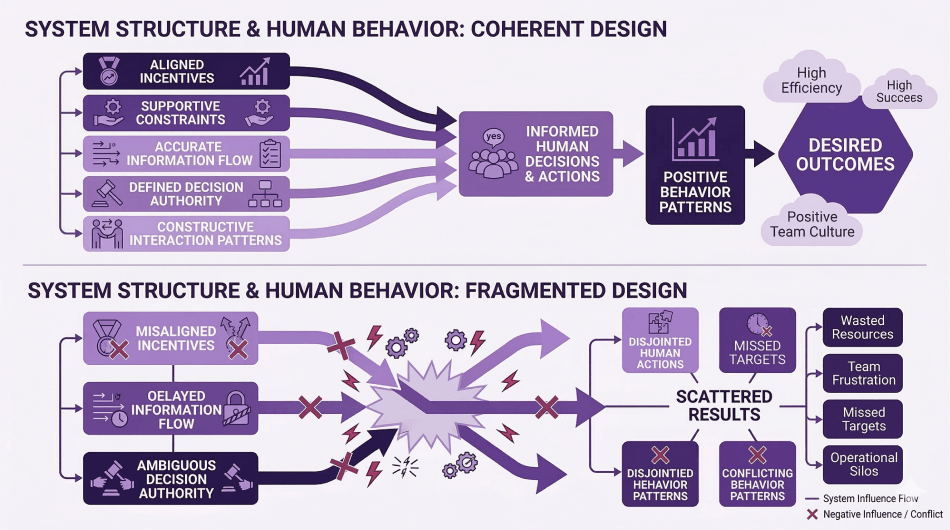
Human behavior inside complex environments is strongly influenced by system structure.
Structures shape behavior through several mechanisms:
- incentives that reward certain actions
- constraints that limit available options
- information flows that determine what participants know
- decision authority that defines who can act and when
- interaction patterns that shape coordination between participants
These structural elements create an operating environment.
Within that environment, individuals adapt their behavior to succeed, complete tasks, or manage constraints.
Because participants respond to similar structural pressures, consistent patterns of behavior often emerge across different individuals occupying the same roles.
In this way, systems influence behavior without explicitly directing it.
The structure changes the conditions under which decisions are made, and behavior adjusts accordingly.
Structural Translation
In simple terms, people often behave in ways that make sense within the system they are in.
If a system rewards speed, people prioritize quick results.
If it rewards caution and approval, people move carefully and wait for permission.
If information is limited, decisions are made with partial understanding.
The behavior that appears to belong to the individual may actually be a response to the surrounding structure.
When the structure changes, behavior often changes as well.
Structural Implication
When behavior problems are interpreted only as personal issues, organizations may overlook structural influences.
Common responses include:
- coaching individuals without adjusting system incentives
- asking for better communication without improving information flow
- encouraging initiative in systems that discourage risk-taking
- holding people accountable for outcomes they cannot structurally influence
These approaches focus on individuals while leaving the surrounding system unchanged.
As a result, the same behavior patterns often reappear.
Leverage Insight
People adapt to the systems they operate within.
Understanding behavior therefore requires examining the structures shaping available choices.
Systems Language makes these structural influences visible, allowing behavior to be understood as a product of the environment rather than only the individual.
Pillar: Systems Language — perception.