

Some organizations appear to function smoothly even as conditions change.
Projects move forward without constant supervision. Teams coordinate effectively. Decisions flow through the system without unnecessary delays.
In other environments, even small disruptions create confusion. Responsibilities overlap, priorities shift unexpectedly, and progress slows whenever pressure increases.
The difference is often not the capability of the people involved.
It is the structural integrity of the system they operate within.
Systems Layer
Structural integrity refers to the degree to which a system’s components are organized in a way that allows it to maintain stable and reliable performance.
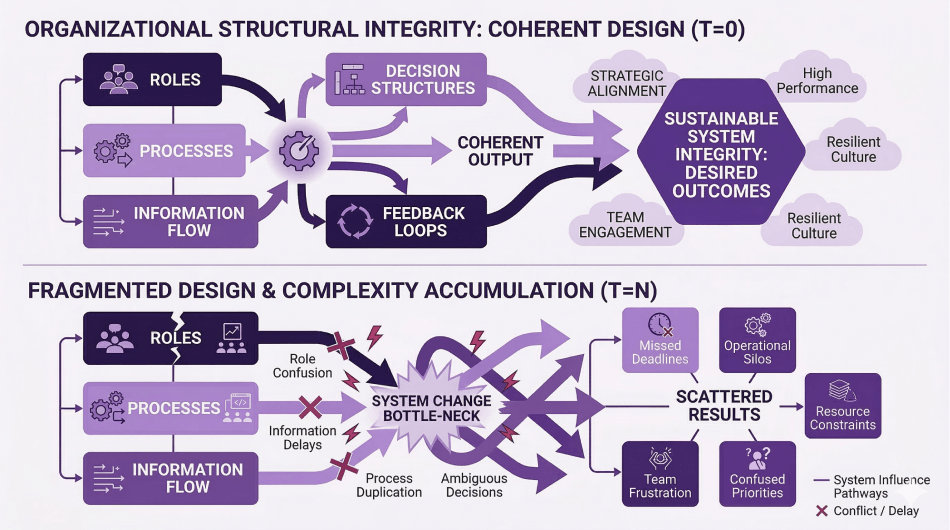
In organizational systems, structural integrity depends on the alignment and interaction of several key elements:
- clear roles and responsibilities that define who performs which functions
- coherent processes that guide work from initiation to completion
- reliable information flows that allow participants to coordinate actions
- appropriate constraints and decision structures that regulate activity
- balanced feedback loops that stabilize performance over time
When these structural elements are well designed and properly aligned, the system distributes work efficiently and adapts to changes without breaking down.
Structural integrity allows the system to maintain coherence under pressure.
Structural Translation
In simple terms, structural integrity means that the system is built in a way that holds together when work becomes complex.
People understand their roles. Processes guide how work moves forward. Information reaches the right places at the right time.
Because the structure is stable, individuals do not need to constantly improvise or compensate for missing connections.
The system itself supports consistent performance.
Structural Implication
When structural integrity is weak, organizations often rely on individuals to compensate for gaps in the system.
Common symptoms include:
- frequent coordination problems
- unclear ownership of tasks or decisions
- excessive meetings to resolve structural confusion
- reliance on a few individuals to keep the system functioning
In these situations, performance depends heavily on personal effort rather than system design.
Strong structural integrity reduces this burden by embedding stability directly into the system.
Leverage Insight
Organizations perform consistently when their structures maintain integrity under changing conditions.
Systems Language helps reveal whether the connections between roles, processes, and information flows are strong enough to support stable system behavior.
Pillar: Systems Language — perception.
