

Decisions in complex environments rarely produce simple outcomes.
A change intended to improve efficiency may create new bottlenecks elsewhere. A policy designed to solve one problem may introduce unexpected side effects. A strategic initiative may succeed initially but later encounter limits that were not anticipated.
These situations are not usually caused by poor intentions.
They occur because decisions interact with systems that contain many interconnected parts.
Without understanding those structures, decision-makers are often responding only to the visible surface of the system.
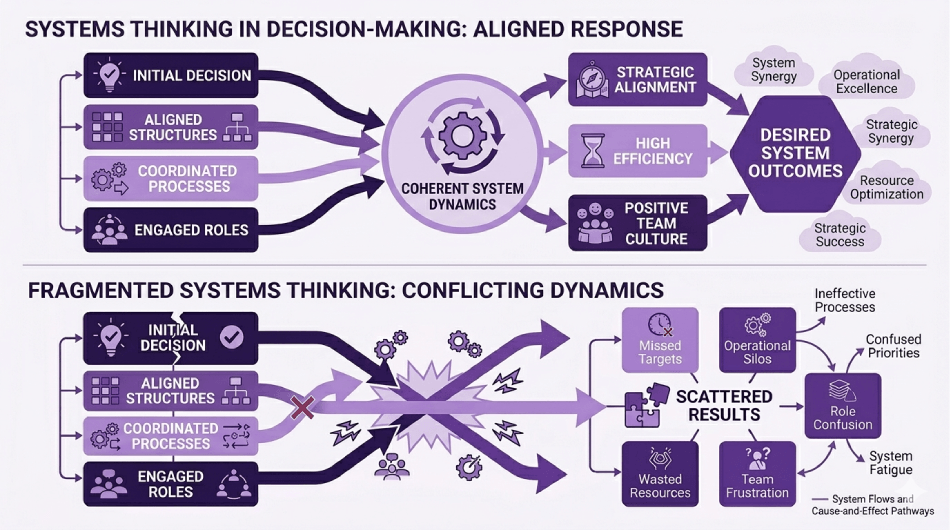
Systems Layer
Systems thinking in decision-making involves examining the structural conditions that shape how a decision will influence the broader system.
Rather than evaluating a decision in isolation, this approach considers how the decision interacts with:
- existing system structures such as roles, processes, and constraints
- interdependencies between different components of the system
- feedback loops that may amplify or stabilize the effects of the decision
- time delays that separate actions from visible outcomes
- resource flows and information signals that influence system behavior
These elements determine how the system will respond once the decision is introduced.
A decision does not operate independently. It enters an existing network of interactions that shape its eventual effects.
Structural awareness therefore allows decision-makers to anticipate how system dynamics may influence outcomes.
Structural Translation
In simple terms, systems thinking encourages decision-makers to ask a broader set of questions.
Instead of focusing only on whether a decision solves an immediate problem, they consider:
- how the decision will affect other parts of the system
- whether existing structures will support or resist the change
- whether feedback loops will amplify or limit the effect
- how long it may take before the system responds
By examining these structural relationships, decisions are made with a clearer understanding of how the system will behave.
Structural Implication
When decisions are made without structural awareness, unintended consequences become more likely.
Common patterns include:
- solving one problem while creating another elsewhere
- introducing initiatives that conflict with existing system constraints
- reacting to short-term signals without considering delayed effects
- misinterpreting system feedback after changes are introduced
These issues occur because the decision interacts with system dynamics that were not considered during the decision process.
Systems thinking helps reduce these risks by expanding the scope of analysis beyond the immediate event.
Leverage Insight
Better decisions come from better understanding of the system in which the decision operates.
Systems Language provides a framework for examining structures, interactions, and feedback dynamics — allowing decisions to be evaluated within the full context of the system.
Pillar: Systems Language — perception.
