

Unexpected disruptions are a normal part of complex environments.
A supply chain breaks down. A key team member leaves. Demand shifts suddenly. External conditions change faster than expected.
Some systems struggle when these disruptions occur. Work stops, coordination breaks down, and recovery takes significant time and effort.
Other systems absorb the disturbance and continue functioning. They adapt, reorganize, and stabilize without collapsing.
The difference often lies in how the system is designed.
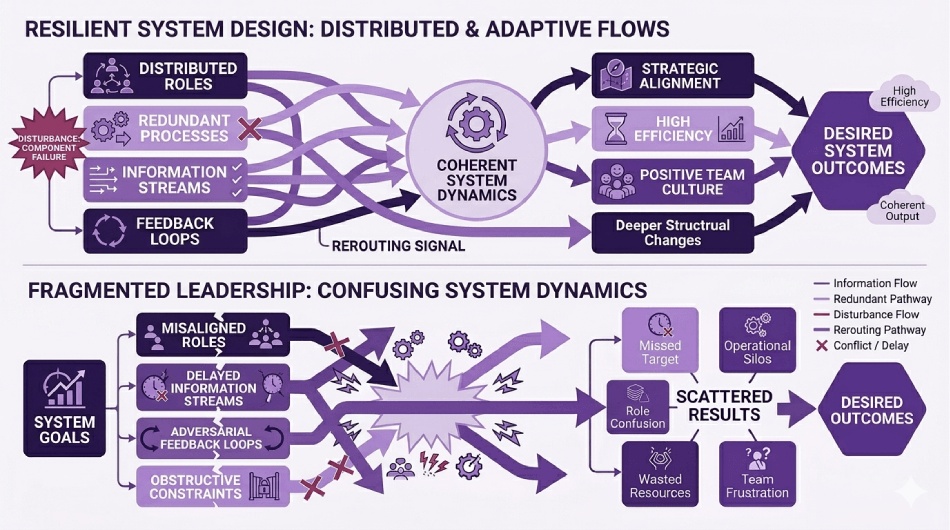
Systems Layer
Resilience in a system refers to its ability to continue functioning when conditions change or disturbances occur.
Structural resilience emerges from design features that allow the system to adapt without losing coherence.
These features often include:
- distributed responsibilities rather than dependence on a single critical node
- redundant pathways that allow work or information to move through alternative channels
- clear feedback mechanisms that allow the system to detect disruptions quickly
- balanced constraints that stabilize behavior without preventing adaptation
- flexible coordination structures that allow components to reorganize when necessary
These elements allow the system to respond dynamically when disruptions occur.
Instead of failing at a single point, the system redistributes activity and continues operating.
Resilience therefore depends not only on strength, but on structural adaptability.
Structural Translation
In simple terms, resilient systems are designed so that one disruption does not break the entire system.
For example:
- if information can travel through multiple channels, communication continues even if one channel fails
- if responsibilities are shared or distributed, the system can adjust when one role changes
- if feedback signals quickly reveal problems, the system can respond before disruption spreads
These structural features allow the system to absorb shocks and reorganize itself.
The system remains functional even when conditions change.
Structural Implication
When systems lack resilience, disruptions tend to spread quickly.
Common vulnerabilities include:
- heavy dependence on a single person, team, or resource
- rigid processes that cannot adjust to changing conditions
- limited communication pathways that fail when one channel breaks
- slow feedback signals that delay detection of emerging problems
These structures create fragile systems where small disturbances can produce large operational failures.
Designing for resilience requires identifying these vulnerabilities and building structural alternatives.
Leverage Insight
Resilient systems are not simply strong.
They are designed to adapt.
Systems Language helps identify where structures concentrate risk and where additional pathways, feedback, or flexibility can increase the system’s ability to withstand disruption.
Pillar: Systems Language — perception.
