
Complex situations often feel overwhelming.
Multiple teams are involved. Information arrives from many directions. Problems appear interconnected but difficult to explain. Decisions produce results that are hard to predict.
When complexity increases, it becomes difficult to see what is actually happening.
People may focus on isolated issues or attempt to manage each problem individually. Yet this approach rarely produces clarity.
Understanding complex environments often requires a different way of seeing the situation.
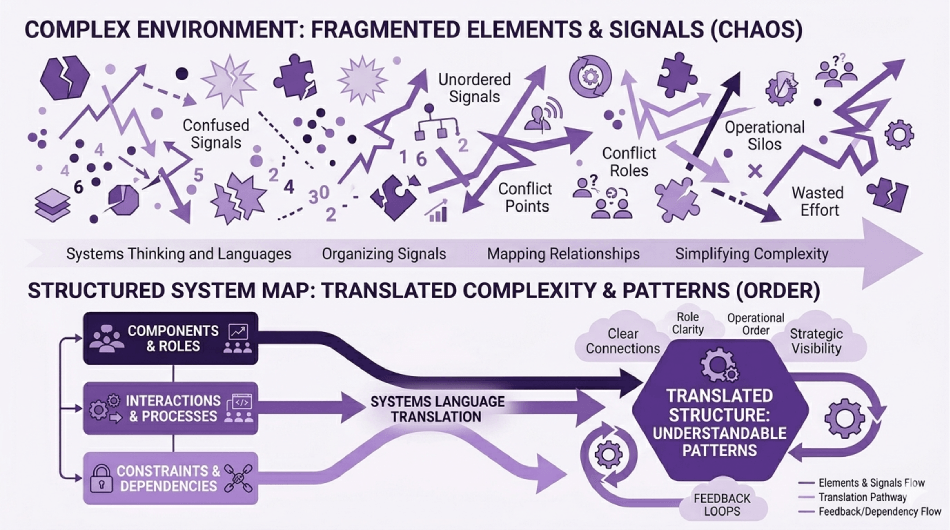
Systems Layer
Complex environments contain many interacting components, feedback loops, constraints, and dependencies.
Viewed directly, this network of interactions can appear chaotic.
Systems Language provides a method for translating this complexity into structured representations that reveal patterns.
This translation involves identifying and organizing key structural elements such as:
- system components — the actors, resources, or processes involved
- interaction pathways — how components influence each other
- constraints and boundaries — limits shaping system behavior
- feedback loops — mechanisms that amplify or stabilize change
- dependency relationships — connections that link outcomes across the system
By mapping these elements, complex situations can be reframed as structured systems rather than collections of unrelated events.
Once the structure is visible, patterns and causal relationships become easier to understand.
Structural Translation
In simple terms, Systems Language helps turn a confusing situation into a map of how things are connected.
Instead of trying to track every individual event, the observer identifies:
- the main parts of the system
- how those parts interact
- where constraints or feedback loops influence behavior
This creates a structured picture of the system.
What initially seemed complicated becomes a set of understandable patterns.
Structural Implication
Without structural translation, complex environments often produce reactive decision-making.
Common outcomes include:
- treating each problem as a separate issue
- reacting to events without understanding their connections
- introducing solutions that unintentionally create new problems elsewhere
- losing clarity as complexity increases
Systems Language allows complexity to be organized rather than avoided.
By translating complexity into structure, decision-makers gain a clearer view of how the system behaves and where meaningful interventions may exist.
Leverage Insight
Complexity does not disappear when systems become difficult to understand.
But it can be translated into structure.
Systems Language provides the tools to map interactions, constraints, and feedback relationships so that complex environments become understandable and navigable.
Pillar: Systems Language — perception.