
In complex environments, people are constantly surrounded by activity.
Meetings occur, decisions are made, projects move forward, and problems appear unexpectedly. The surface of the system is filled with events.
Because these events demand immediate attention, most people learn to respond quickly and move on.
But over time, a pattern becomes clear. The same kinds of problems repeat. Similar delays reappear. The same coordination challenges return even after changes are made.
Responding to events alone rarely explains why these patterns persist.
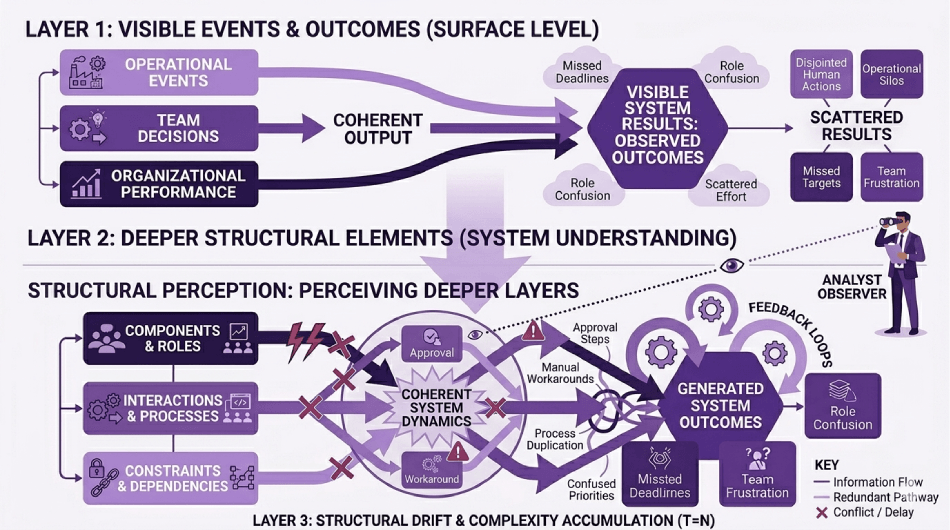
Understanding the system requires the ability to see something deeper than the events themselves.
Systems Layer
Structural perception is the ability to recognize the underlying arrangements that generate system behavior.
Rather than focusing only on visible actions or outcomes, structural perception examines:
- structures that organize roles, processes, and resources
- constraints that limit or guide system activity
- interactions that connect components across the system
- feedback loops that amplify or stabilize change
- dependencies and delays that shape how effects unfold over time
These elements form the architecture of the system.
When structural perception is applied, outcomes can be interpreted as expressions of these underlying arrangements rather than as isolated events.
This perspective allows complex environments to be analyzed and redesigned with greater clarity.
Structural Translation
In simple terms, structural perception is the skill of seeing how a system is set up.
Instead of focusing only on what people did, it asks:
- What structure produced this outcome?
- How are the parts of the system connected?
- Where do constraints or feedback loops influence behavior?
- What interactions are shaping the pattern we observe?
By asking these questions, complex situations become understandable as system patterns rather than individual incidents.
Structural Implication
Without structural perception, individuals and organizations often remain trapped in cycles of reactive problem-solving.
Typical patterns include:
- repeatedly addressing symptoms rather than structural causes
- introducing solutions that create unintended consequences elsewhere
- attributing recurring outcomes to individuals rather than system design
- responding to events without recognizing underlying patterns
These responses consume effort while leaving system behavior largely unchanged.
Developing structural perception enables people to move beyond reaction and toward system diagnosis and design.
Leverage Insight
Structural perception transforms how complex environments are understood.
By learning to recognize structures, interactions, and feedback dynamics, people gain the ability to diagnose system behavior and redesign systems more effectively.
In this way, Systems Language becomes not just a concept, but a practical capability for navigating complexity.
Pillar: Systems Language — perception.