
The System Perception and Feedback Model illustrates how systems observe their own performance and adjust behavior over time. Unlike linear systems that simply produce outcomes, adaptive systems monitor results, interpret signals, and use that information to guide future actions.
This diagram shows a continuous control loop in which system activity produces outcomes, outcomes generate measurement signals, and those signals are evaluated to inform future decisions. Through this cycle, the system learns from experience and gradually improves how it operates.
At the center of the model is the perception-driven control loop, representing the ongoing process through which systems observe, evaluate, and adapt.
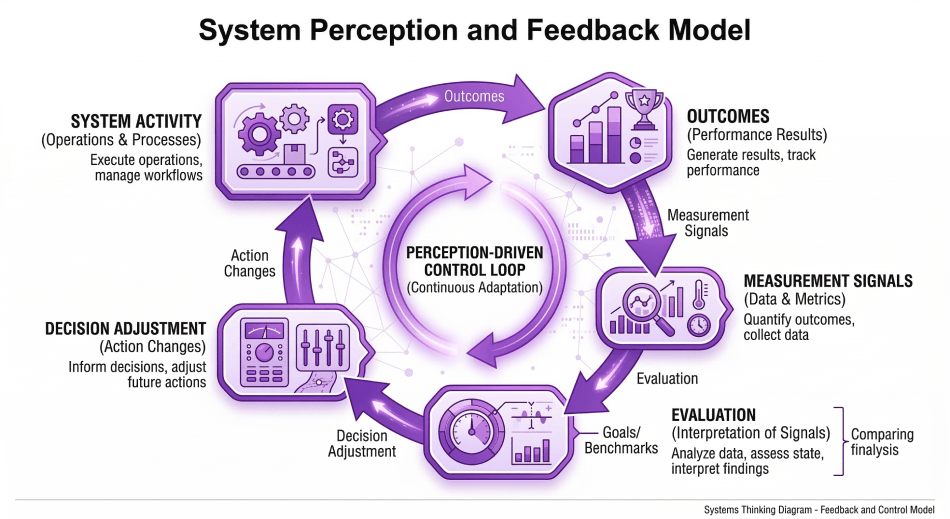
System Activity
The cycle begins with system activity. This includes the operational processes and actions through which the system performs its work.
Examples of system activity may include executing workflows, delivering services, manufacturing products, or processing information. These activities represent the operational behavior of the system.
At this stage the system is simply acting according to its existing structure, procedures, and decision rules. The quality of these actions will determine the outcomes that follow.
Outcomes
System activity produces outcomes. Outcomes represent the measurable results generated by the system’s behavior.
These results may include performance metrics such as output levels, quality measures, financial performance, customer satisfaction, or operational efficiency.
Outcomes are important because they provide observable evidence of how well the system is functioning. Without measurable outcomes, the system has no way to evaluate whether its behavior is producing the desired results.
Outcomes therefore become the foundation for feedback.
Measurement Signals
Once outcomes occur, the system converts those outcomes into measurement signals.
Measurement signals are the quantified data and metrics that describe system performance. These signals may include production counts, error rates, response times, financial indicators, or other performance indicators.
Measurement signals transform raw outcomes into information that can be analyzed. They allow the system to observe its own behavior in a structured and measurable way.
Without reliable measurement signals, systems cannot effectively learn from experience.
Evaluation
Evaluation is the stage where the system interprets the signals it receives.
During evaluation, measurement data is compared against goals, benchmarks, or performance expectations. The system analyzes the signals to determine whether results are meeting desired standards or whether adjustments are necessary.
This stage represents the system’s perceptual process. Just as organisms interpret sensory signals from their environment, systems interpret measurement signals to understand their current state.
Evaluation turns raw data into actionable insight.
Decision Adjustment
Once signals have been interpreted, the system adjusts its actions.
Decision adjustment represents the process of modifying behavior based on what the system has learned from its evaluation stage. This may involve altering workflows, reallocating resources, adjusting priorities, or refining operational processes.
These adjustments are typically incremental and occur within the existing system structure. They allow the system to respond to feedback without requiring major redesign.
The adjusted actions then re-enter the system activity stage, completing the loop.
The Perception-Driven Control Loop
The central loop in the diagram represents continuous adaptation.
Each cycle of activity, measurement, evaluation, and adjustment allows the system to refine how it operates. Over time, this process can significantly improve system performance because decisions are guided by observed results rather than assumptions.
This loop mirrors control systems found in engineering, biology, and organizational systems. Thermostats, autopilot systems, and operational dashboards all rely on similar feedback mechanisms.
In each case, the system adjusts behavior in response to observed performance.
Structural Translation
Many real-world systems rely on this perception and feedback structure.
In organizations, management dashboards and performance reviews serve as measurement systems that inform decision adjustments. In manufacturing, quality monitoring systems provide feedback that guides production improvements.
In digital platforms, analytics systems track user behavior and performance metrics, allowing operators to refine system behavior continuously.
Wherever systems measure outcomes and use those measurements to guide decisions, this feedback model is present.
Structural Implication
When feedback systems are clear and reliable, organizations learn quickly. Problems are detected early, decisions are guided by evidence, and performance improves steadily over time.
When feedback systems are weak or unclear, learning slows dramatically. Decisions may rely on assumptions, outdated information, or incomplete signals.
In such environments, systems often repeat mistakes because they lack accurate information about their own behavior.
Effective feedback mechanisms therefore play a critical role in system stability and improvement.
Leverage Insight
The most powerful way to improve adaptive systems is to strengthen the feedback loop.
Improving measurement accuracy, clarifying performance signals, and ensuring that decision-makers receive timely information allows the system to respond more intelligently to changing conditions.
When systems can clearly perceive their own outcomes, they gain the ability to adjust behavior continuously.
Over time, this perception-driven learning process becomes one of the most powerful mechanisms for sustained system improvement.