
In many teams, certain people gradually become the place where everything lands.
They answer questions no one else can resolve. They fix problems that were not originally theirs. They become the person who “just knows how things work,” so work naturally flows toward them.
At first this looks like competence. The system appears to run because someone capable is holding things together.
But over time, that same reliability becomes a structural burden.
Systems Layer
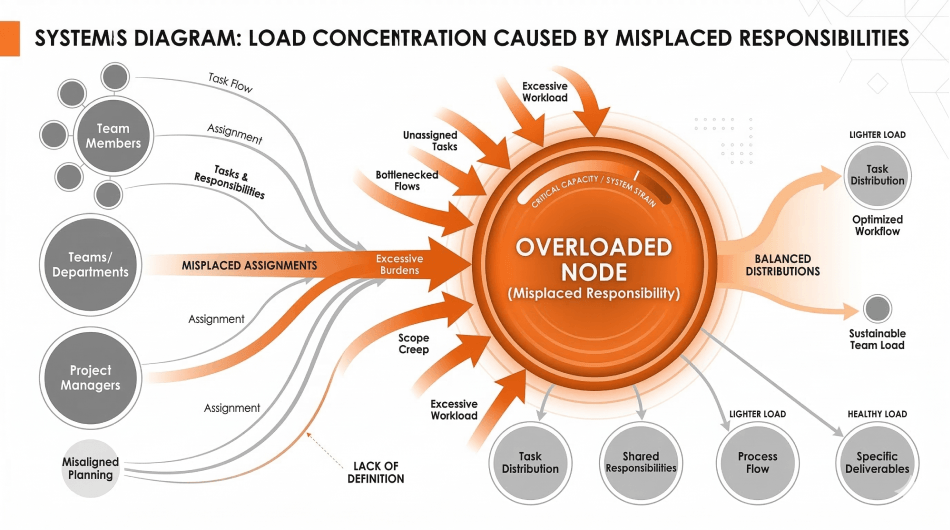
In systems terms, inefficiency often emerges when load is mislocated.
Every system distributes responsibilities across nodes—people, roles, tools, or processes. Each node has a finite processing capacity determined by time, attention, and decision bandwidth.
When responsibilities sit on the wrong node, the system begins to exhibit structural overload.
This occurs when a node is forced to process tasks that structurally belong elsewhere in the system—whether in another role, another process, or another subsystem.
The result is not simply higher workload.
It produces load concentration, where signals, decisions, and operational tasks converge around a single point in the system.
Load concentration increases coordination dependency and reduces system resilience. When that node slows down, the entire system slows with it.
Structural Translation
In simple terms, systems become unstable when the wrong people end up holding the wrong responsibilities.
Instead of work flowing through clearly defined roles, everything starts routing through the same person or small group.
That person becomes the translator, the problem solver, and the safety net.
The system works—but only because someone is absorbing complexity that should have been distributed elsewhere.
Eventually the system becomes dependent on that individual just to function.
Structural Implication
When organizations ignore load placement, several predictable patterns appear.
Key individuals become decision bottlenecks. Teams begin waiting for approvals, clarifications, or fixes that only certain people can provide.
At the same time, other parts of the system remain underutilized because responsibility boundaries are unclear.
This produces a fragile structure. The system operates efficiently only while the overloaded node continues to absorb the excess work.
When that node becomes unavailable—through burnout, absence, or role change—the hidden structural imbalance suddenly becomes visible.
What looked like productivity was actually misplaced load.
Leverage Insight
From the perspective of Outsourcing and Load Distribution, the key question is not how hard people are working.
The key question is:
“Is the load sitting on the correct nodes in the system?”
System stability improves not by increasing effort, but by placing responsibility where the system can process it most effectively.