
When work begins to spread across multiple people, teams often expect things to become easier.
Tasks are shared. Responsibilities are distributed. No single person is carrying everything anymore.
But something else often happens instead.
Questions start appearing. Work overlaps. Certain tasks get done twice while others quietly fall through the gaps. The system has more people involved—but not necessarily more clarity.
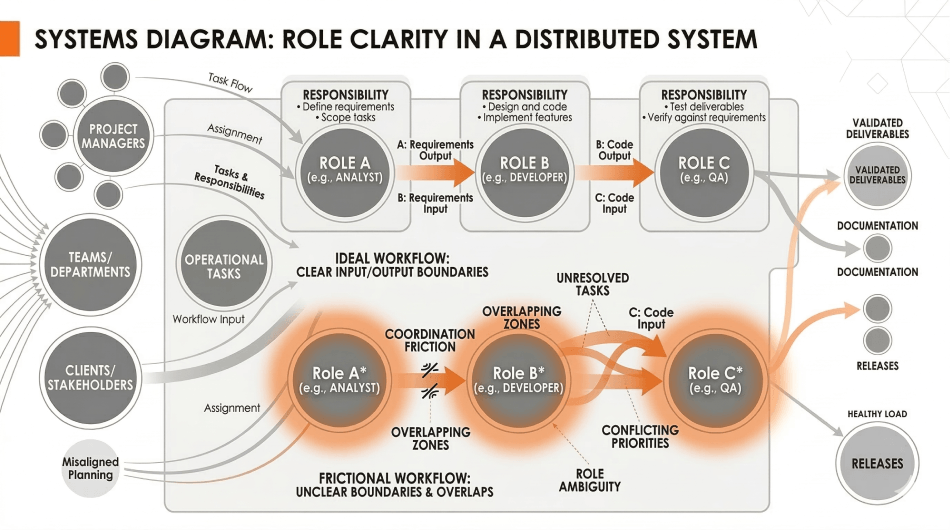
Systems Layer
In distributed systems, work moves across multiple processing nodes.
Each node—whether a person, team, or external provider—interacts with the system through defined responsibilities and decision boundaries.
For the system to operate efficiently, each node must have a clearly defined role interface. This interface specifies:
- what the node is responsible for
- what inputs it receives
- what outputs it produces
- what decisions it is allowed to make
Role clarity therefore functions as a coordination structure.
Without clearly defined role interfaces, the system cannot reliably route work. Signals become ambiguous, responsibilities overlap, and nodes begin compensating for uncertainty by checking, confirming, or duplicating work.
The result is a rise in coordination load across the entire system.
Structural Translation
In simple terms, when many people are involved in the same workflow, everyone needs to know exactly where their responsibility begins and ends.
A role is not just a job title.
It is a clear understanding of:
- what you handle
- what you don’t handle
- when work moves to someone else
When those boundaries are clear, work flows smoothly from one person to the next.
When they are unclear, people spend more time figuring out who should do something than actually doing it.
Structural Implication
When role clarity is missing in distributed systems, several predictable patterns appear.
Work stalls because people wait for someone else to take ownership. Multiple people attempt the same task because the boundaries were never defined. Small decisions escalate upward because no one knows who has authority to make them.
These problems are often mistaken for communication issues.
In reality, they are structural ambiguity.
The system lacks clear responsibility interfaces, so coordination becomes dependent on constant clarification.
As systems grow and work becomes more distributed, this ambiguity multiplies rapidly.
Leverage Insight
Within the Outsourcing and Load Distribution pillar, distributing work only improves system performance when responsibility boundaries are structurally clear.
Load can move efficiently through a system only when each node understands the role it plays in processing that load.
Role clarity turns distributed work from confusion into coordinated flow.