
When work is shared across multiple people or teams, progress depends on more than just effort.
One person completes a task and passes it forward. Another role reviews the output and moves it into the next stage. External partners contribute specialized work that feeds back into the internal system.
When everything flows smoothly, the system feels efficient.
But when information gets delayed, misunderstood, or lost between roles, the entire workflow begins to stall—even if everyone involved is working hard.
Systems Layer
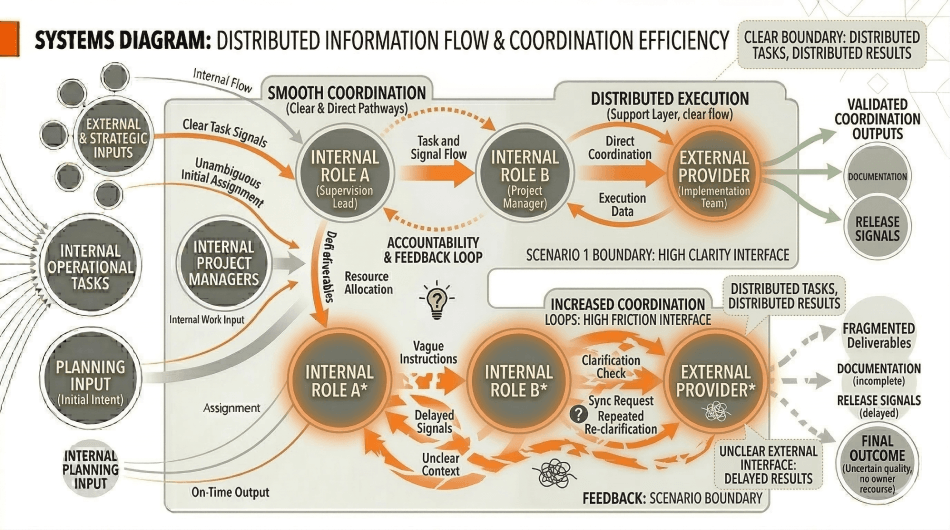
A distributed system relies on information flow to coordinate activity between nodes.
Each node processes work based on the signals it receives. These signals may include instructions, constraints, context, feedback, or status updates.
For the system to function reliably, information must move through stable pathways connecting these nodes.
In outsourced environments, these pathways cross organizational boundaries. Internal roles and external providers must exchange signals that allow work to be processed independently while remaining aligned with system requirements.
When information flows cleanly, nodes can act with confidence and autonomy.
When information flow becomes inconsistent—delayed signals, missing context, fragmented updates—nodes begin compensating through repeated clarification, redundant checks, or cautious decision-making.
The system slows not because tasks are difficult, but because coordination signals cannot move reliably.
Structural Translation
In simple terms, distributed work depends on people having the right information at the right time.
Each person or team needs enough context to complete their part of the work without constantly stopping to ask for clarification.
If information arrives late, incomplete, or confusing, work slows down.
People pause to verify details, wait for updates, or redo tasks that were based on incorrect assumptions.
The work may still move forward, but it moves through friction rather than flow.
Structural Implication
When information flow breaks down in outsourced systems, coordination effort increases across the entire structure.
Internal teams spend time tracking progress instead of advancing the work. External partners struggle to interpret requirements or anticipate changes. Tasks accumulate in waiting states while roles attempt to synchronize their understanding.
These symptoms are often interpreted as performance issues between teams.
In reality, the system lacks reliable information pathways connecting its distributed nodes.
Without these pathways, the system must rely on constant supervision and reactive communication.
Leverage Insight
Within the Outsourcing and Load Distribution pillar, distributed systems succeed when information moves through predictable and reliable channels.
Work can only flow smoothly when the signals guiding that work travel clearly between roles.
Reliable information flow turns distributed effort into coordinated system behavior.