

In many organizations, certain individuals quietly accumulate more and more work.
They take on extra tasks. They answer questions that others could handle. They solve problems directly rather than passing them to the appropriate role.
Even when they are clearly overloaded, they hesitate to delegate or outsource the work.
From the outside, this behavior looks puzzling. The system offers ways to distribute the load, yet the work remains concentrated in one place.
Systems Layer
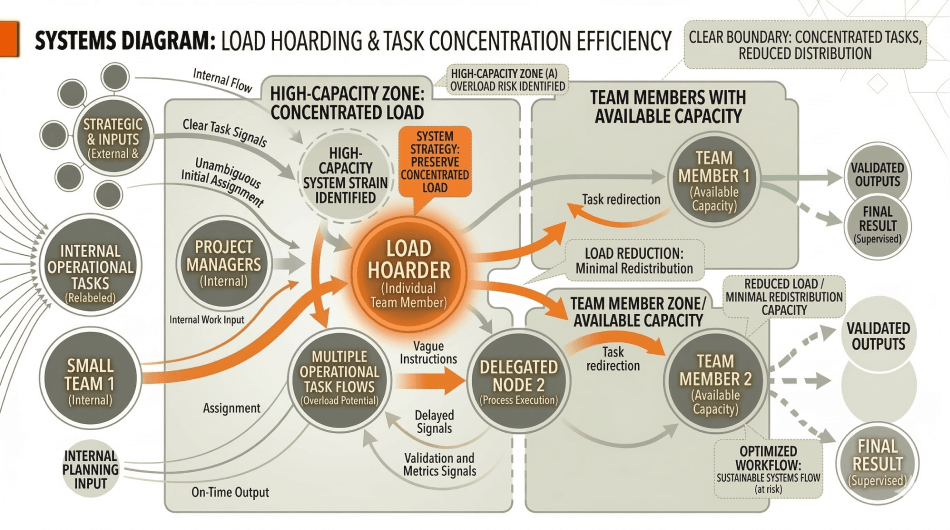
Load hoarding occurs when a system node continues absorbing responsibilities even after reaching its processing limits.
In a well-balanced system, operational load distributes across nodes based on defined roles and capacity. However, structural signals within organizations sometimes encourage load retention rather than distribution.
Several mechanisms can create this behavior.
First, control signals may reward individuals for maintaining ownership over tasks, especially when outcomes are closely tied to reputation or authority.
Second, trust gaps within the system may cause individuals to believe that other nodes cannot reliably process the work.
Third, interface ambiguity may make delegation cognitively expensive. If transferring work requires extensive explanation or supervision, it can appear easier to simply process the task internally.
These forces cause the node to continue accumulating load, even when system capacity would improve through redistribution.
Structural Translation
In simple terms, people sometimes hold onto work because letting go feels risky or complicated.
They may worry that the work will not be done correctly. They may feel responsible for maintaining quality. Or they may believe that explaining the task will take longer than completing it themselves.
Over time, this leads to a pattern where the same person becomes the default processor for many tasks.
The system adapts around that behavior, and more work naturally flows toward them.
Structural Implication
Load hoarding creates systems that appear efficient at first but gradually become fragile.
Because one node holds a large share of operational responsibility, the system becomes dependent on that individual’s availability and attention.
Other nodes remain underutilized, and the system’s overall capacity remains lower than it could be.
When the overloaded node reaches its limits—or becomes unavailable—the system suddenly reveals how much hidden load it was carrying.
What appeared to be individual productivity was actually structural imbalance.
Leverage Insight
Within the Outsourcing and Load Distribution pillar, sustainable systems encourage load mobility rather than load concentration.
Work must be able to move to nodes with available capacity.
When systems reduce the friction and risk associated with delegation, load begins to distribute naturally across the structure.
