

When organizations are small, work often flows through a few central people.
Founders make most decisions. Team members handle a wide variety of tasks. Information moves quickly because everyone shares the same context.
For a time, this structure works well.
But as the organization grows, the number of tasks, decisions, and coordination points increases rapidly. The same structure that once felt agile begins to slow down.
Growth introduces complexity that cannot pass through a single center.
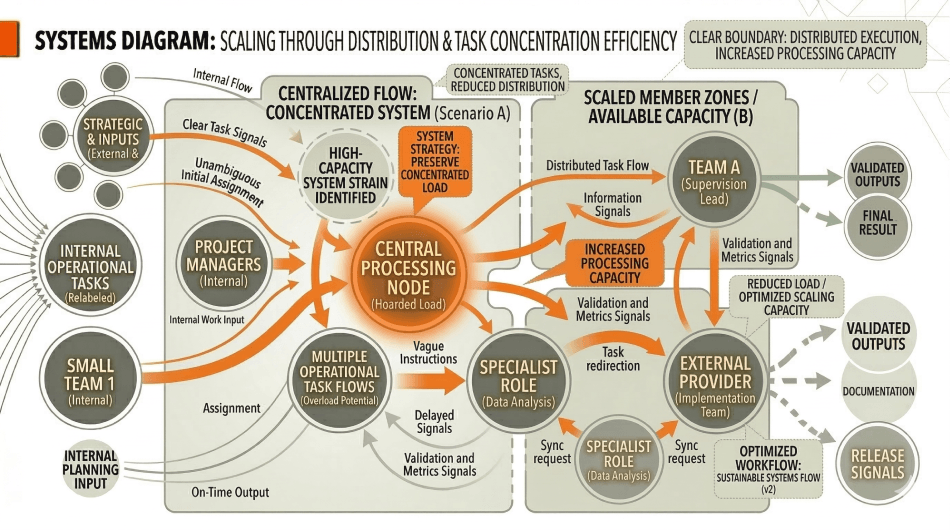
Systems Layer
Scaling systems face a fundamental constraint: centralized processing capacity.
In small systems, a limited number of nodes can manage most operational and decision activity. As system size increases, however, the volume of signals, tasks, and coordination requirements expands beyond what centralized nodes can process.
To remain functional, the system must transition toward distributed processing.
Distributed structures divide work across specialized nodes—teams, roles, or external providers—each responsible for processing a defined portion of the system’s operational load.
These nodes operate semi-independently while remaining connected through information signals and coordination mechanisms.
Distribution allows the system to increase total processing capacity without overwhelming any single node.
In effect, the system scales by expanding its processing network rather than enlarging a central hub.
Structural Translation
In simple terms, growing organizations cannot rely on a few people to handle everything.
As the amount of work increases, the system must spread that work across more roles, teams, and sometimes external partners.
Each group takes responsibility for a specific part of the system’s operations.
Instead of everything passing through one center, work moves through many connected paths.
This allows the organization to handle more activity without slowing down.
Structural Implication
When growing systems attempt to maintain centralized structures, predictable bottlenecks appear.
Key leaders become overwhelmed with approvals and decisions. Teams wait for direction from the same few people. Progress slows because too much activity depends on a limited number of nodes.
In contrast, systems that successfully scale build distributed work structures.
Responsibilities become clearer. Teams develop specialized roles. External providers may handle defined operational functions.
The system expands its ability to process complexity by distributing the load across more capable nodes.
Leverage Insight
Within the Outsourcing and Load Distribution pillar, scaling is fundamentally a load distribution challenge.
Growth succeeds when systems expand their processing capacity by distributing work across well-defined nodes while maintaining clear signals between them.
Distribution transforms increasing complexity into manageable system flow.
