
Many teams attempt to outsource work in order to reduce pressure on internal capacity.
Tasks are transferred to external providers or other teams with the expectation that the workload will decrease. At first the transition appears straightforward—someone else is now responsible for completing the task.
But over time, problems begin to surface. Instructions require constant clarification. Outputs vary from one cycle to the next. Internal teams must repeatedly intervene to correct or adjust the work.
The task has moved outside the system, yet the effort required to manage it has not.
Systems Layer
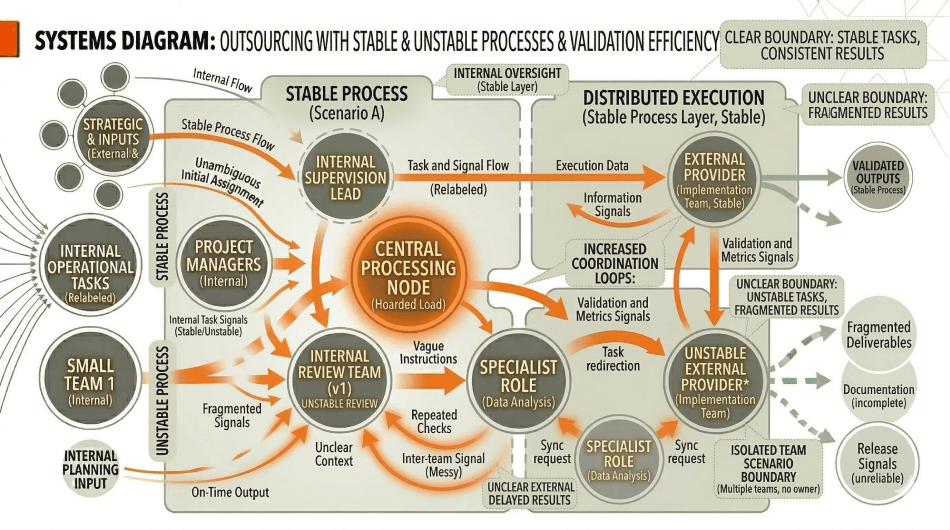
Outsourcing relies on process stability.
A process is the sequence of signals, actions, and outputs that convert inputs into results within a system. When that sequence is stable, it behaves predictably across repeated cycles.
Stable processes have several structural characteristics:
- consistent inputs
- defined transformation steps
- predictable outputs
- clear feedback signals
When these conditions exist, tasks can move across system boundaries without requiring constant interpretation. External nodes can process the work because the process itself provides the structure needed for execution.
When processes are unstable, however, outsourcing becomes difficult.
If inputs change unpredictably, steps vary between cycles, or outputs lack clear definitions, external nodes must rely on continuous clarification from the internal system.
In these conditions, the system exports the task but retains the cognitive burden of interpreting the process.
Structural Translation
In simple terms, outsourcing works best when the work follows a clear and repeatable process.
If the steps are consistent and the expected results are well understood, another team can handle the work without constant guidance.
But if the process changes every time or depends on unwritten knowledge, the external team cannot operate independently.
The internal system then spends its time explaining what should happen during each cycle.
Structural Implication
When organizations attempt to outsource unstable processes, the expected efficiency gains rarely appear.
External providers must frequently request clarification. Internal teams must monitor outputs closely to correct deviations. Work moves forward through repeated adjustments rather than predictable flow.
This situation often leads organizations to believe outsourcing itself is ineffective.
In reality, the underlying process lacks the stability required for independent execution.
Outsourcing amplifies the instability that already existed within the system.
Leverage Insight
Within the Outsourcing and Load Distribution pillar, effective task distribution depends on process stability.
Stable processes allow work to move across system boundaries with minimal supervision, transforming outsourcing from a coordination burden into a genuine expansion of system capacity.