

When work moves across teams or external partners, trust quickly becomes a central concern.
Leaders often ask whether they can trust another team to complete the work correctly. Team members may hesitate to rely on people they do not interact with regularly.
At first glance, trust appears to depend on individual reliability or personal relationships.
Yet in many well-functioning systems, people collaborate effectively even when they have never met each other.
The trust exists not only between individuals, but within the structure of the system itself.
Systems Layer
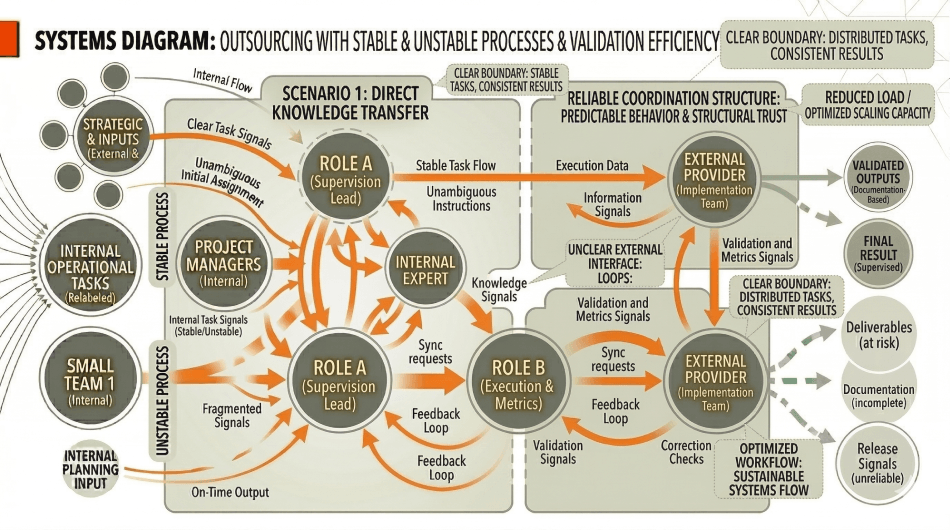
In distributed systems, trust emerges from predictable system behavior.
Nodes in the system—people, teams, or external providers—process work according to defined roles, stable processes, and consistent communication signals.
When these structural elements remain reliable, system participants can anticipate how other nodes will behave even without direct personal familiarity.
Three structural conditions typically generate this form of trust:
- Role reliability — each node consistently performs its defined responsibilities
- Process stability — tasks move through repeatable and predictable workflows
- Signal clarity — communication signals provide accurate information about status, expectations, and outcomes
Together, these conditions create structural predictability.
Predictability allows nodes to coordinate effectively because they can rely on the system’s structure rather than on individual interpretation or personality.
Structural Translation
In simple terms, trust in distributed work grows when the system behaves consistently.
If roles are clear, processes are stable, and communication is reliable, people begin to trust the system itself.
They know what to expect from each part of the workflow.
Instead of constantly verifying every step, they can rely on the structure to guide the work.
Trust becomes a property of how the system operates, not just who happens to be involved.
Structural Implication
When systems lack structural clarity, trust becomes fragile.
People rely on personal judgment rather than predictable workflows. Tasks require constant checking because roles and expectations remain uncertain. Communication becomes cautious because signals may be incomplete or misleading.
In these conditions, collaboration depends heavily on personal relationships and individual reliability.
This approach works in small systems but becomes difficult to maintain as work expands across teams and organizations.
Without structural trust, distributed systems struggle to coordinate at scale.
Leverage Insight
Within the Outsourcing and Load Distribution pillar, trust becomes scalable when it is embedded in system structure.
Reliable roles, stable processes, and clear signals allow distributed work to function smoothly—even when participants do not share direct relationships.
Structural trust turns coordination from personal effort into predictable system behavior.
