
When work is distributed across many people, teams, or external partners, coordination becomes more complex.
Each role focuses on its own tasks. Each team optimizes its own workflow. External contributors complete the assignments they receive.
From the perspective of each individual role, the work may appear successful.
Yet the overall system can slowly drift away from its intended priorities because no shared direction is guiding how those individual efforts fit together.
Systems Layer
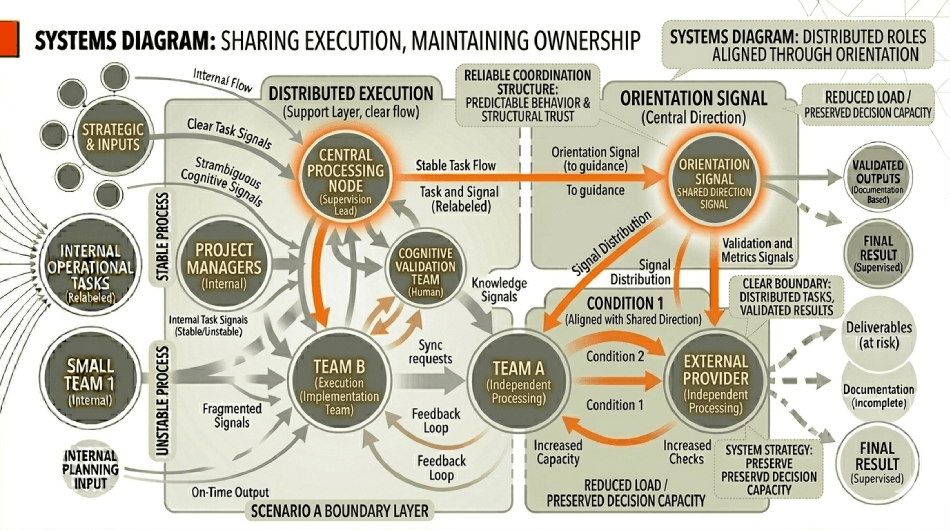
Distributed systems require orientation signals to maintain alignment.
Orientation defines the direction of the system—its priorities, objectives, and criteria for success. These signals guide how individual nodes interpret tasks and make local decisions.
In centralized systems, orientation often remains implicit because decision-making happens in a small group. As systems distribute work across multiple nodes, however, each node begins processing tasks independently.
Without clear orientation signals, nodes optimize their local activities based on incomplete or inconsistent assumptions.
The system continues to produce output, but those outputs may not converge toward the system’s intended goals.
Orientation functions as a global reference signal.
It allows distributed roles to process tasks autonomously while still aligning their actions with the broader direction of the system.
Structural Translation
In simple terms, when many people contribute to the same system, everyone needs to understand what direction the system is moving in.
If that direction is unclear, each team may make reasonable decisions based on its own perspective—but those decisions may not fit together.
Clear direction helps distributed roles interpret their work correctly.
It ensures that even when tasks are performed in different places, they still move the system toward the same outcome.
Structural Implication
When orientation signals are weak or inconsistent, distributed systems experience gradual misalignment.
Teams may focus on efficiency while leadership prioritizes innovation. External providers may optimize for speed while internal roles prioritize quality. Different parts of the system begin pulling in different directions.
Because each node is acting logically within its own context, the misalignment can remain invisible for long periods.
The system produces activity, but not coherent progress.
Clear orientation signals prevent this drift by giving distributed roles a shared directional reference.
Leverage Insight
Within the Orientation pillar, direction acts as the stabilizing signal for distributed work.
When roles across the system understand the same priorities and objectives, distributed execution can occur without losing alignment.
Orientation allows complexity to expand while keeping the system moving in a coherent direction.
Diagram Prompt
0421 Create a clean systems diagram showing distributed roles aligned through orientation. Include multiple nodes labeled Team A, Team B, and External Provider processing tasks independently. At the top, include a central Orientation Signal representing system direction. Use arrows from the orientation signal to each node to illustrate how shared direction guides distributed task processing. Use a minimal, professional systems-thinking style with clear directional flows. Landscape Ratio, blue style
Post Image Prompt
Create a conceptual illustration representing orientation in distributed systems. Show several workers positioned in different locations, each performing tasks while following a shared directional signal such as a guiding light or arrow pointing toward a common destination. The workers remain aligned despite being physically separated. Use a clean modern editorial illustration style with simple shapes and a neutral background to symbolize coordinated direction. Landscape Ratio, blue style