

When teams begin distributing work, the goal is usually simple: reduce overload and allow more people to contribute.
Tasks move across roles, responsibilities expand to new contributors, and sometimes external partners become involved. On the surface, the workload appears to be shared.
But over time, subtle signals begin to appear. Certain people remain overwhelmed. Questions repeatedly return to the same individuals. Work seems to circulate between roles without actually progressing.
The system has technically distributed tasks—but something about the distribution is not working.
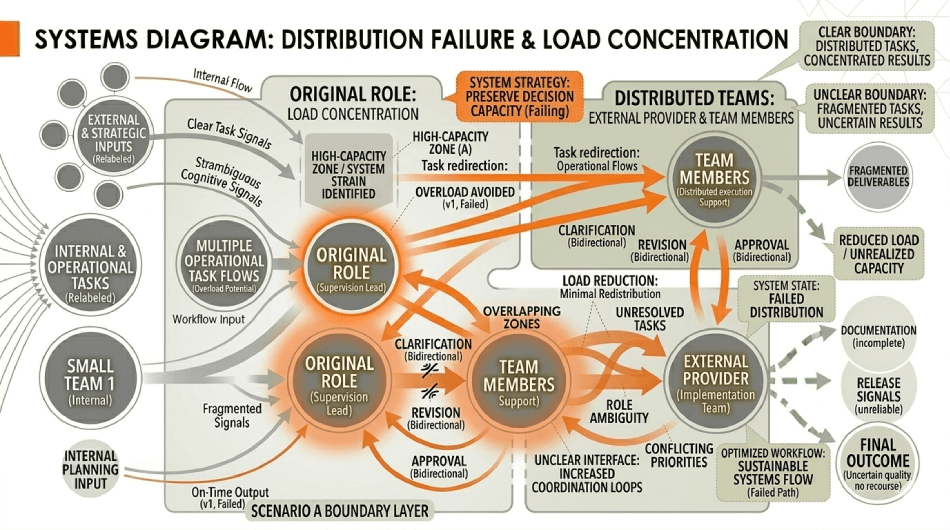
Systems Layer
Load distribution functions properly when operational tasks move to nodes that can process them independently.
Each node must receive sufficient signals—context, expectations, and decision boundaries—to process the load without continuous reattachment to the originating node.
Distribution failures occur when this independence does not exist.
Instead of processing tasks autonomously, nodes repeatedly send signals back to the origin for clarification, correction, or decision-making. This produces recirculation loops within the system.
Several structural symptoms typically appear:
- Load rebound — tasks return to the original node for revision or completion
- decision bottlenecks — multiple workflows converge on the same individual for approvals
- clarification loops — repeated questions about expectations or requirements
- supervisory overload — internal roles spend more time monitoring work than performing it
These patterns indicate that the system has transferred execution but not fully transferred processing responsibility.
Structural Translation
In simple terms, distributed work should allow tasks to move forward without constantly returning to the same person.
If someone delegates a task but still has to answer many questions, review every step, or fix the result afterward, the work has not truly left their workload.
Instead, the system is circulating the task through multiple people while still depending on the original source.
The work moves around, but the load remains concentrated.
Structural Implication
When distribution failures persist, organizations often respond by adding more contributors or increasing oversight.
These responses rarely solve the underlying issue.
Additional contributors increase coordination load, while increased oversight concentrates more responsibility on supervisory roles.
The deeper problem lies in the structure of the load transfer.
Without clear responsibilities, stable processes, and reliable signals, distributed nodes cannot process work independently.
The system appears busy, but its operational load remains structurally concentrated.
Leverage Insight
Within the Outsourcing and Load Distribution pillar, successful distribution reduces the number of times work must reconnect with its original source.
When tasks move through the system with minimal recirculation, load has been structurally redistributed rather than simply reassigned.
Diagram Prompt
0422 Create a clean systems diagram illustrating distribution failure. Include nodes labeled Original Role, Team Members, and External Provider. Show tasks moving outward from the original role but repeatedly looping back through arrows labeled Clarification, Revision, and Approval. Highlight the recirculation loops indicating that load remains concentrated at the original node. Use a minimal, professional systems-thinking style with clear directional flows. Landscape Ratio, blue style
Post Image Prompt
Create a conceptual illustration representing distribution failure. Show tasks being passed between several workers in a circular pattern, repeatedly returning to the same overloaded individual at the center. The central worker appears overwhelmed while others continue passing the task around. Use a clean editorial illustration style with simple shapes and a neutral background to symbolize load recirculation in a system. Landscape Ratio, blue style
