

When work is distributed across multiple roles or teams, leaders often face a familiar tension.
If they monitor everything closely, the system begins to feel slow and constrained. Every step waits for approval, and contributors hesitate to act without confirmation.
But if oversight disappears entirely, the system can drift. Decisions are made independently, sometimes moving in directions that do not align with broader priorities.
The challenge is not choosing between control and autonomy. The challenge is balancing them within the system’s structure.
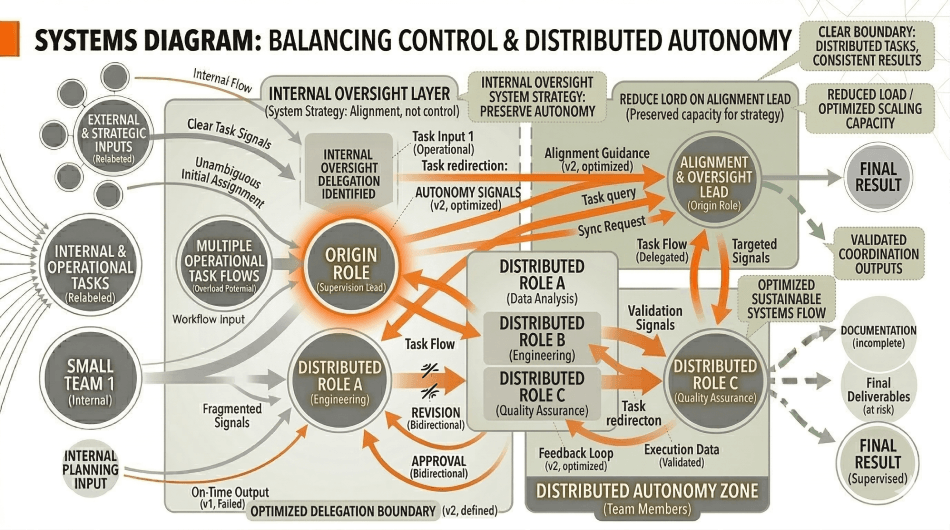
Systems Layer
Distributed systems operate through multiple processing nodes working semi-independently.
For the system to function effectively, each node must have enough autonomy to process tasks without constant supervision. This autonomy allows the system to scale its processing capacity and respond quickly to local signals.
However, distributed nodes must still remain aligned with the system’s overall direction.
This alignment requires oversight signals—feedback mechanisms that allow the system to observe outcomes, detect deviations, and adjust behavior when necessary.
The system therefore relies on two complementary structures:
- role autonomy, which enables independent task processing
- system oversight, which maintains alignment with overall goals
When these structures are balanced, nodes operate independently while still contributing to coordinated system behavior.
Structural Translation
In simple terms, people need enough freedom to do their work, but the system still needs a way to ensure everything is moving in the right direction.
If every action requires approval, the system becomes slow and overloaded.
If there is no oversight at all, different parts of the system may begin working toward different outcomes.
Clear roles allow individuals to act independently, while oversight signals help the system stay coordinated.
Structural Implication
When systems lean too far toward control, they create decision bottlenecks.
Important roles become overloaded with approvals and monitoring responsibilities. Contributors hesitate to act because they depend on constant confirmation.
When systems lean too far toward autonomy, coordination begins to weaken.
Teams may optimize their local work while unintentionally drifting away from shared priorities. Problems remain undetected because no signals exist to reveal misalignment.
Stable distributed systems maintain structured autonomy—clear decision boundaries combined with feedback signals that preserve system coherence.
Leverage Insight
Within the Outsourcing and Load Distribution pillar, effective delegation requires both role independence and system visibility.
Autonomy allows nodes to process work efficiently, while oversight ensures that distributed activity remains aligned with the system’s direction.
Together, these forces create distributed systems that are both scalable and coordinated.
