

Sometimes a very small change suddenly makes everything easier.
A single automation removes hours of manual work. A simple rule clarifies dozens of decisions. A well-placed template eliminates constant re-explaining.
From the outside, these improvements can look surprisingly small compared to the impact they create.
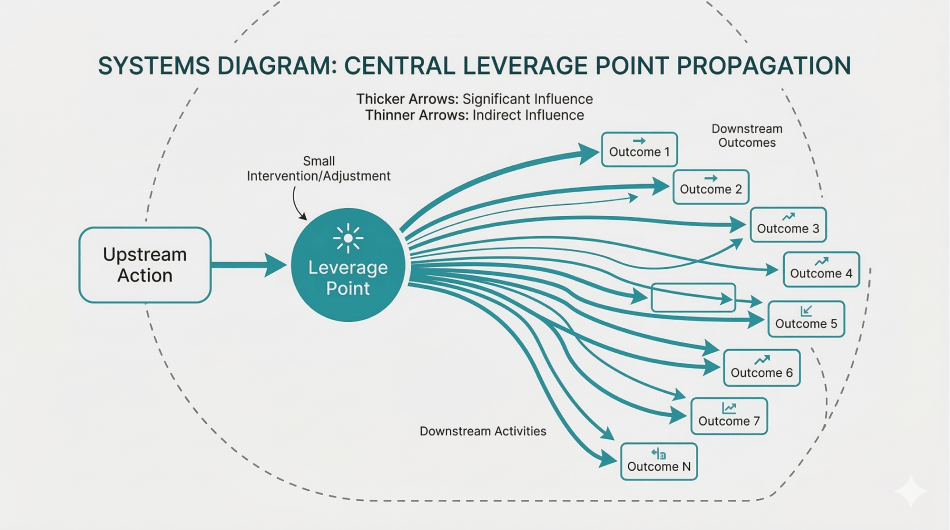
The reason is structural: some actions sit at key leverage points inside a system.
Systems Layer
AtomIQ describes the discipline of identifying atomic structural actions that produce disproportionate effects within a system.
In systems terms, most environments contain many low-leverage activities and a small number of high-leverage structural nodes.
These nodes often take the form of:
- constraint points
- coordination mechanisms
- decision rules
- information flows
- repeatable processes
When a structural intervention modifies one of these nodes, the change propagates through the system’s interactions and workflows.
Because the intervention sits upstream of many downstream activities, its effect multiplies across the system.
This creates what appears to be a large outcome from a very small action.
Structural Translation
In simple terms, AtomIQ is about finding the small moves that change a lot of things at once.
Instead of trying to work harder across the entire system, the focus shifts to improving the few places that influence everything else.
Examples include:
- adding a shared template that standardizes communication
- defining a clear rule that removes repeated decisions
- automating a step that appears in dozens of workflows
- reorganizing information so people can find what they need instantly
Each of these changes may be small in effort but large in effect because they sit at structural leverage points.
Structural Implication
When systems ignore leverage points, improvement efforts tend to spread across many small activities.
Teams try to fix problems everywhere:
- more meetings
- more coordination
- more manual work
- more explanations
The result is higher cognitive load without meaningful structural change.
Without identifying leverage nodes, systems often become busier rather than more effective.
The system continues to produce the same friction because the underlying structure has not changed.
Leverage Insight
AtomIQ is the practice of locating the smallest structural intervention that shifts the behavior of the entire system.
The power is not in doing more work.
The power is in placing a small action at the point where the system multiplies its effect.
