
Many people assume that solving a difficult situation requires a large amount of effort.
When work becomes chaotic, the natural reaction is to push harder: add more meetings, write more plans, increase oversight, or deploy more people.
But in many real environments, large efforts often produce surprisingly small improvements.
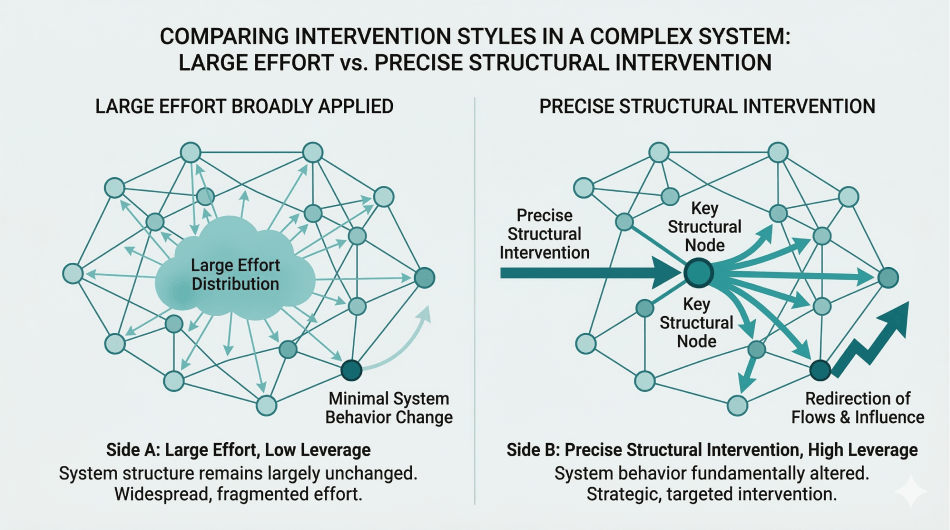
At the same time, a single precise adjustment — a rule change, a tool, or a redesigned workflow — can suddenly remove friction across the entire system.
Systems Layer
Complex systems do not respond linearly to effort.
Instead, their behavior is shaped by structures such as:
- feedback loops
- constraints
- information flows
- coordination mechanisms
- decision rules
Because these structures organize how work moves through the system, interventions that modify them can produce disproportionately large effects.
In systems terms, effort applied inside the system’s existing structure tends to scale linearly.
Effort applied to the structure itself changes how the system behaves.
This distinction is what creates the difference between large effort and high leverage.
A small structural intervention placed at a point of coordination or constraint can redirect the behavior of many interacting components simultaneously.
Structural Translation
In simple terms, complex environments often improve more from precise adjustments than from more effort.
Imagine a team that spends hours each week clarifying tasks.
Adding more meetings might slightly improve coordination.
But introducing a simple shared task board may eliminate most of the confusion instantly.
The task board did not add more effort.
It changed the structure of information flow in the system.
Because many activities depended on that information, the effect spread quickly.
This is why small structural moves can outperform large operational efforts.
Structural Implication
When organizations treat complex problems as effort problems, they often respond by increasing activity.
Common responses include:
- expanding reporting requirements
- adding layers of coordination
- assigning more people to the same workflow
- increasing supervision
These actions increase the system’s workload but rarely change its structure.
As a result, the same inefficiencies persist.
The system becomes heavier and slower while producing only marginal improvements.
Without structural intervention, complexity continues to amplify friction.
Leverage Insight
Complex systems reward precision more than scale.
The most effective improvements come from identifying the structural point where a small intervention changes how the system behaves.
This is the foundation of AtomIQ: finding the smallest move that shifts the system’s trajectory.