
When progress stalls, the instinctive response is often to push harder.
Teams increase effort. More meetings are scheduled. More oversight is introduced. Deadlines tighten, and activity intensifies.
Yet despite the increased energy, the system may still resist movement. Work continues to feel heavy, coordination remains difficult, and results improve only slightly.
In many cases, the issue is not effort. The issue is structural alignment.
Systems Layer
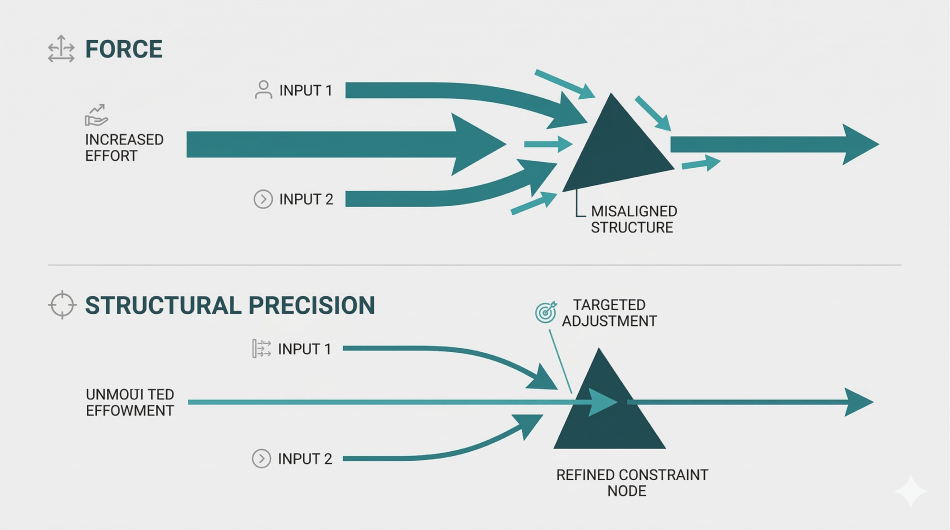
Systems respond to structural conditions more than to raw effort.
A system is shaped by constraints, information flows, coordination mechanisms, and feedback loops. These elements determine how activity moves through the environment.
When these structural elements are misaligned, additional effort tends to amplify friction rather than reduce it.
For example:
- A workflow with unclear decision authority produces repeated coordination delays.
- An information system with fragmented access creates repeated searching and clarification.
- A process with poorly defined handoffs generates recurring confusion.
Applying additional effort within these conditions increases activity but does not resolve the structural misalignment.
Structural precision, by contrast, focuses on adjusting the system at the point where misalignment occurs. Once the structure shifts, the system’s behavior changes with far less effort.
Structural Translation
In simple terms, pushing harder does not help if the system itself is working against you.
If the structure creates confusion or friction, more effort only means people struggle more inside the same problem.
But a precise structural adjustment can remove the obstacle entirely.
Examples include:
- clarifying a single decision rule
- redesigning a workflow handoff
- consolidating information into one accessible location
- automating a repetitive coordination step
These changes may be small, but they remove the structural friction that effort alone cannot overcome.
Structural Implication
When organizations rely on force instead of structural precision, systems often become overloaded.
Common responses include:
- increased supervision
- expanded reporting requirements
- additional coordination meetings
- tighter deadlines
These measures raise pressure but rarely improve system alignment.
Over time, the environment becomes more exhausting while underlying inefficiencies persist.
Without structural correction, effort accumulates without meaningful change.
Leverage Insight
Force increases pressure inside a system.
Structural precision changes the conditions that shape system behavior.
AtomIQ focuses on finding the precise adjustment that allows the system to move with less resistance.
Diagram Prompt
0507 Create a clean systems diagram comparing “Force” versus “Structural Precision.” On one side, show increased effort applied across many system components but blocked by a structural constraint labeled “Misaligned Structure.” On the other side, show a targeted adjustment at the constraint node that redirects flows and allows activity to move smoothly through the system. Use arrows to illustrate resistance versus smooth flow. Style should be minimalistic with clear labels and a neutral background. Landscape ratio, blue style
Post Image Prompt
Create a conceptual illustration representing structural precision versus force. Show one side with people pushing hard against a locked or misaligned mechanism, while the other side shows a small precise adjustment unlocking the system and allowing it to move easily. Use symbolic elements such as gears, control points, or alignment markers. Style should be modern, clean, and suitable for a professional article header. Landscape ratio, blue style