
Sometimes the most important step in solving a problem is not the solution itself, but what happens before it.
A team may attempt to implement a new process, but adoption stalls. A decision is announced, yet confusion continues. A tool is introduced, but people still rely on old methods.
In these situations, the change itself may be reasonable. The difficulty lies in the conditions surrounding it.
When the environment is not prepared, even well-designed actions struggle to produce results.
Systems Layer
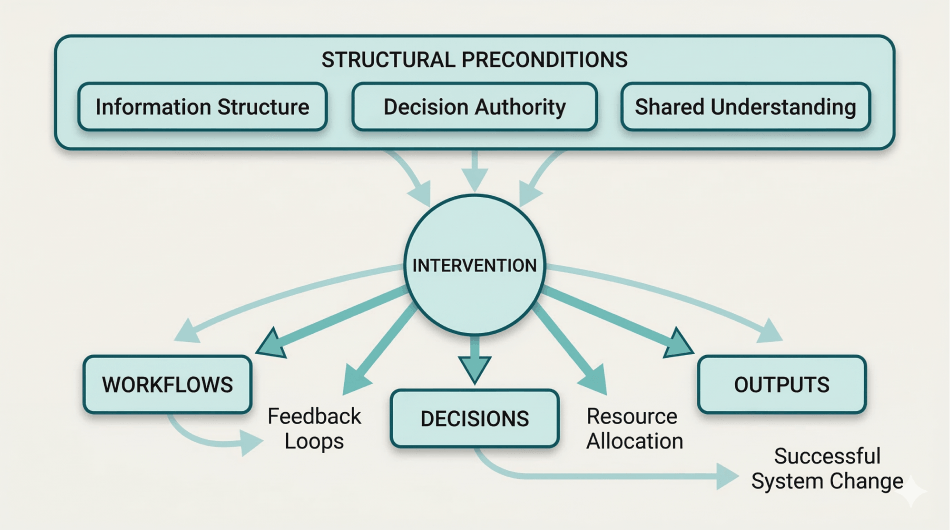
In systems terms, actions operate within a set of structural preconditions.
Preconditions are the conditions that allow an intervention to propagate through a system effectively. These conditions often include:
- shared understanding of goals
- accessible information structures
- clear authority or decision rules
- compatible workflows
- aligned incentives or constraints
If these structural conditions are not present, the system resists the intervention.
The change may technically exist, but it does not integrate into the system’s behavior. Signals fail to propagate, coordination breaks down, and components continue operating under previous assumptions.
When the correct preconditions are established, however, even a small action can move quickly through the system.
The system becomes receptive to the intervention.
Structural Translation
In simple terms, some changes only work after the system is ready for them.
For example:
- A new workflow only works once responsibilities are clearly defined.
- A shared tool only works once information is organized consistently.
- A decision rule only works once everyone understands the criteria.
Without these conditions, the change creates confusion instead of improvement.
Preparing the system first allows the change to function as intended.
Structural Implication
When systems ignore preconditions, change initiatives often appear ineffective.
Organizations may repeatedly introduce:
- new tools
- new processes
- new policies
Yet adoption remains uneven because the surrounding structure has not been prepared.
This leads to cycles of repeated implementation attempts without lasting impact.
The system appears resistant, but the underlying issue is structural readiness.
Leverage Insight
Leverage often begins before the action itself.
AtomIQ recognizes that preparing the right structural conditions allows a small intervention to propagate through the system with minimal resistance.