
Teams often experience coordination problems even when everyone is capable and motivated.
Messages overlap. Responsibilities become unclear. Work is duplicated or delayed because people are waiting on each other without realizing it.
The common response is to increase coordination through more meetings, more updates, or more oversight.
Yet sometimes a very small adjustment — clarifying a role, defining a handoff, or introducing a shared process — suddenly makes the team function more smoothly.
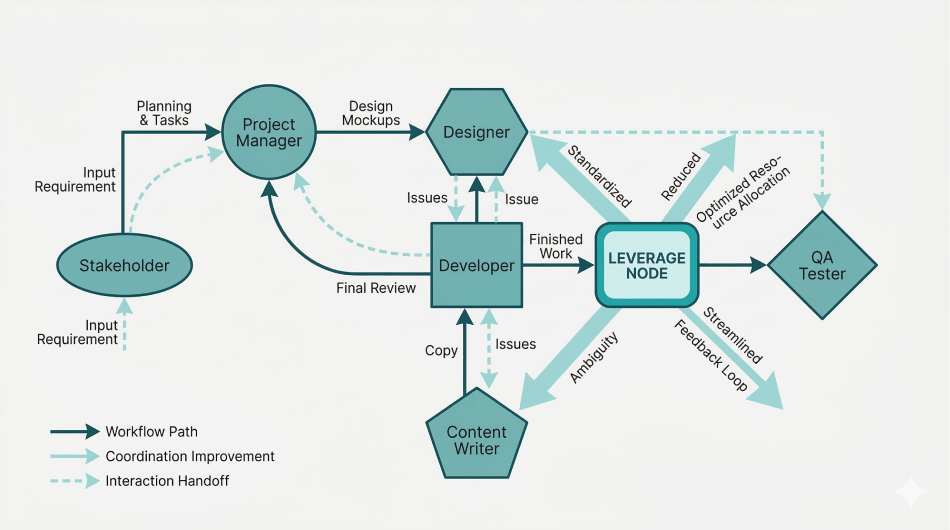
Systems Layer
A team is a coordination system composed of interacting roles, information exchanges, and workflow dependencies.
Within this system, coordination depends on structural elements such as:
- role clarity
- decision authority
- workflow sequencing
- handoff points between tasks
- communication pathways
When these elements are loosely defined, the system relies on constant real-time negotiation. Team members repeatedly clarify responsibilities, confirm decisions, and coordinate actions.
This increases communication load and slows the system.
However, a small structural adjustment at a coordination node can significantly improve system behavior.
Examples include:
- clearly assigning responsibility for a recurring decision
- defining a predictable workflow handoff
- standardizing how updates are communicated
- introducing a shared coordination artifact such as a task board
Because these adjustments affect how the entire group coordinates, the resulting impact extends across many interactions.
Structural Translation
In simple terms, teams often struggle not because people are doing the wrong work, but because the coordination structure is unclear.
Small changes can make a large difference.
For example:
- assigning a single owner for a task removes confusion about responsibility
- defining when a task is considered complete removes repeated checking
- creating a shared view of progress prevents constant status requests
These adjustments reduce the amount of coordination work the team has to perform.
The team spends less time managing the process and more time completing the work.
Structural Implication
When coordination structures remain undefined, teams compensate through increased communication.
This can lead to:
- frequent meetings to synchronize work
- long message threads clarifying responsibilities
- repeated updates about the same tasks
- delays while people wait for confirmation
Over time, coordination effort begins to compete with productive work.
The system becomes communication-heavy rather than outcome-focused.
Leverage Insight
In team systems, leverage often appears in small coordination structures.
AtomIQ focuses on the precise role definitions, process steps, and signals that allow a group to coordinate with less effort and greater clarity.