

Two identical actions can produce very different results depending on when they occur.
A decision made too early may lack the information needed to succeed. The same decision made too late may arrive after the system has already moved in another direction.
In everyday work, timing often determines whether an action simplifies a situation or creates more complexity.
What appears to be a small difference in timing can significantly change the impact of the action.
Systems Layer
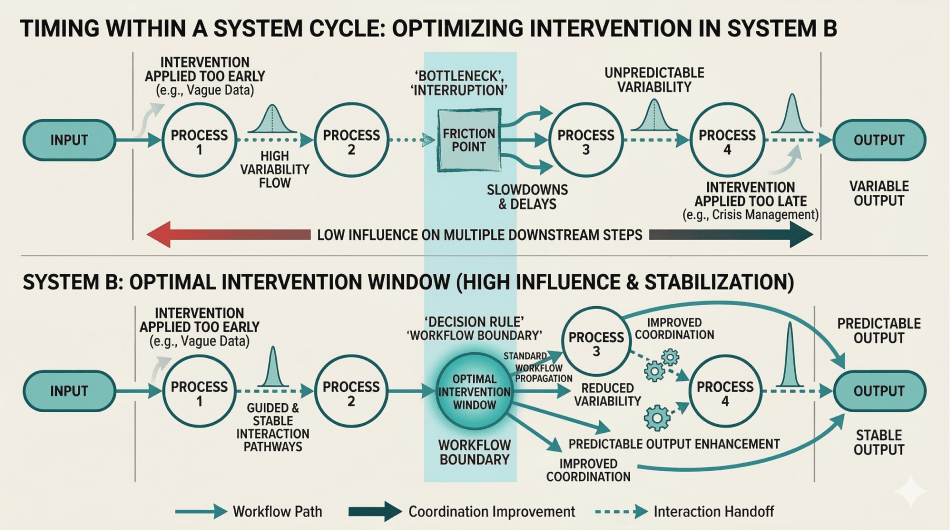
In systems terms, timing determines how an intervention interacts with the system’s current state.
Systems evolve through sequences of signals, decisions, and feedback loops. Each stage of this progression creates a window in which certain actions are more effective than others.
An intervention that aligns with the system’s decision cycle or information flow can propagate quickly through the structure.
However, if the same intervention occurs outside that window, the system may resist or ignore it.
Examples of timing-sensitive structures include:
- decision cycles
- information availability
- workflow stages
- feedback loops
- coordination checkpoints
When an action aligns with these structural rhythms, it can influence many downstream activities.
When it does not, the system may require additional effort to integrate the change.
Structural Translation
In simple terms, the effectiveness of an action often depends on when it happens.
For example:
- clarifying a decision rule before a project begins prevents confusion later
- providing key information at the moment a decision is made improves outcomes
- introducing a new process during a transition phase may be easier than during stable operation
The same action applied at the wrong time may require much more effort to achieve the same result.
Timing determines how easily the system can absorb the change.
Structural Implication
When timing is ignored, interventions often arrive either too early or too late.
Organizations may introduce:
- processes before teams understand their purpose
- decisions after work has already progressed
- information after it is needed for action
These mismatches create rework, confusion, and delays.
The system must either reverse previous activity or operate without the intended guidance.
Without attention to timing, even well-designed interventions lose much of their potential impact.
Leverage Insight
Timing is a structural variable that shapes how an intervention interacts with system behavior.
AtomIQ recognizes that a precisely timed action can amplify its effect across the system with minimal effort.
