

Many problems in organizations begin with small misunderstandings.
A task is interpreted differently by two people. A deadline means one thing to a manager and another to a team member. A process step is followed inconsistently because the expected outcome is not clearly defined.
These issues rarely appear dramatic at first. But as work continues, the misunderstandings multiply, creating delays, repeated conversations, and rework.
Often the solution is surprisingly simple: clarification.
Systems Layer
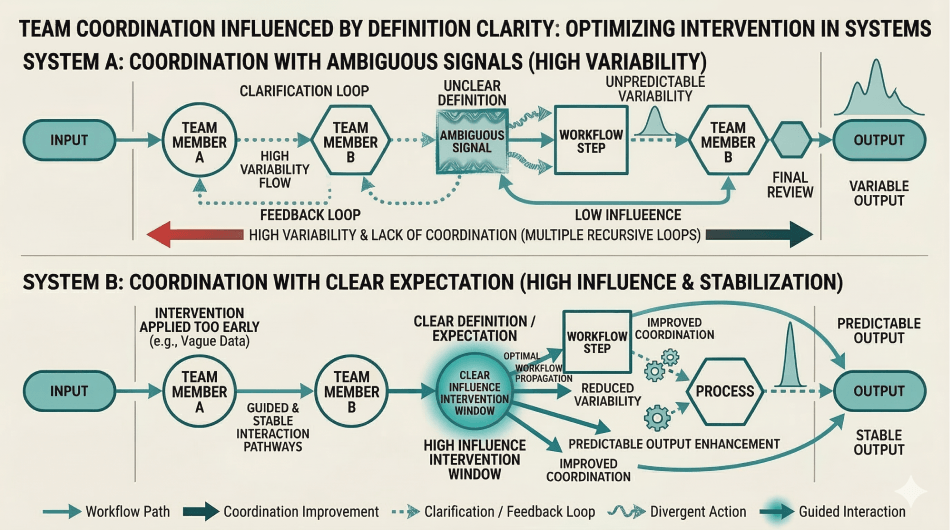
In system environments, clarity acts as a structural signal that aligns the behavior of different components.
Systems operate through shared interpretations of rules, goals, roles, and outputs. When these signals are ambiguous, each component interprets them independently.
This creates divergence in system behavior.
Ambiguity commonly appears in areas such as:
- role responsibilities
- definitions of completion
- decision authority
- workflow expectations
- terminology used within the system
Without consistent interpretation, coordination requires continuous negotiation. Components must repeatedly clarify intentions, confirm expectations, and reconcile differences.
A clear definition or expectation stabilizes these signals.
Once stabilized, many interactions become automatic because participants are responding to the same structural guidance.
Structural Translation
In simple terms, unclear expectations force people to constantly check what something means.
For example:
- If “complete” is not defined, people will ask whether a task is finished.
- If responsibilities are unclear, team members will ask who should act next.
- If terminology varies, discussions will spend time resolving definitions.
When these elements are clearly defined, the system requires far fewer clarification conversations.
People know what to do, when to do it, and how to interpret the outcome.
Structural Implication
When clarification is absent, systems rely on continuous communication to maintain alignment.
This often results in:
- repeated explanations
- ongoing clarification messages
- misunderstandings that require correction
- duplicated or incomplete work
Over time, the communication burden grows as the system attempts to compensate for ambiguous signals.
The work itself may be straightforward, but the coordination becomes heavy.
Leverage Insight
Clarity is a structural signal that aligns system behavior.
AtomIQ recognizes that defining expectations once can remove thousands of small clarification interactions across the system.
