
Learning often feels slow when effort is spread across many different activities.
Someone may read extensively, watch tutorials, and attempt new tasks, yet improvement seems gradual. Progress happens, but it can be difficult to see where the effort is making the biggest difference.
At other times, a specific form of practice combined with immediate feedback suddenly accelerates improvement.
A small adjustment in how learning occurs can significantly change the pace of skill development.
Systems Layer
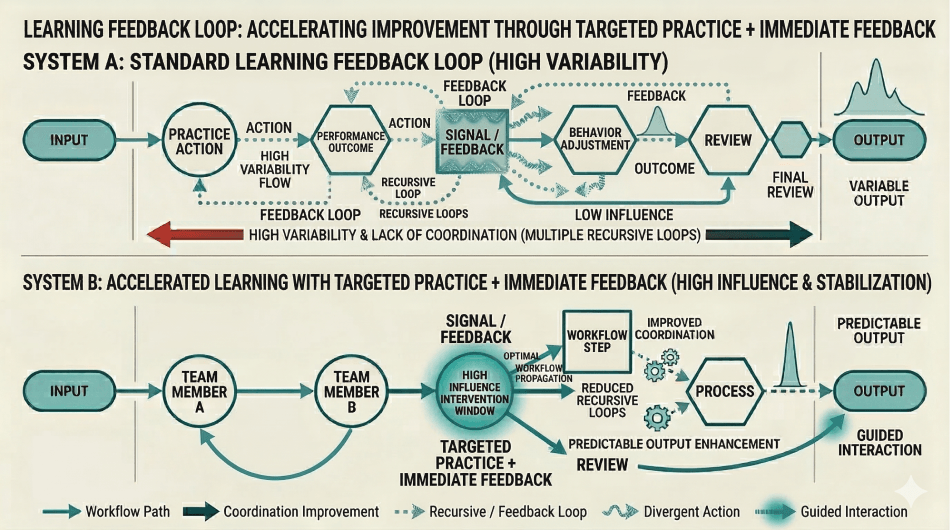
A learning system is a feedback-driven structure that converts experience into improved capability.
The system typically includes several interacting elements:
- practice actions
- performance outcomes
- feedback signals
- adjustment of future behavior
Learning speed depends heavily on how efficiently these elements interact.
When practice is unfocused or feedback is delayed, the system struggles to identify which behaviors should change. The signal that guides improvement becomes weak.
However, targeted practice combined with clear feedback strengthens the feedback loop.
Targeted practice isolates the specific component of skill that requires improvement. Immediate feedback then provides a clear signal about the effectiveness of the attempt.
Because the system quickly receives information about performance, it can rapidly adjust behavior.
Over repeated cycles, this produces accelerated learning.
Structural Translation
In simple terms, people improve faster when they practice the right part of the skill and receive clear feedback on how they performed.
For example:
- practicing a specific technique rather than repeating an entire activity
- receiving immediate correction instead of delayed evaluation
- focusing on one improvement area at a time
These adjustments reduce uncertainty about what needs to change.
The learning system becomes more efficient because each practice cycle produces useful information.
Structural Implication
When learning systems lack targeted practice or timely feedback, improvement slows.
Common patterns include:
- repeating entire activities without isolating weaknesses
- receiving feedback long after the action occurred
- practicing multiple skills simultaneously without focus
In these conditions, the learning signal becomes unclear.
The system continues to accumulate effort, but progress remains gradual because the feedback loop is weak.
Leverage Insight
Learning accelerates when practice and feedback are tightly connected.
AtomIQ recognizes that small adjustments to how practice is structured and how feedback is delivered can significantly increase the effectiveness of the learning system.