

When improvement efforts fail, the explanation is often framed as a lack of effort.
Teams may respond by increasing activity: more planning, more coordination, more detailed procedures. The assumption is that additional work will eventually produce the desired result.
Yet sometimes the opposite happens. Effort increases, but outcomes remain largely unchanged.
The problem in these situations is not the amount of effort. The problem is where the effort is applied.
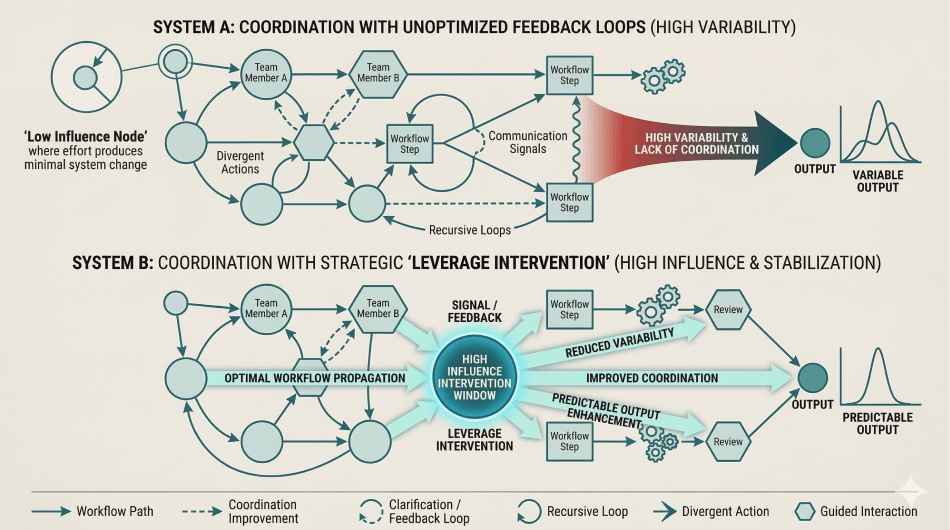
Systems Layer
In systems environments, outcomes are determined by structural relationships rather than by isolated activity.
Every system contains nodes that influence many downstream processes and nodes that influence only a small portion of the system.
When effort is applied to a low-influence node, the system absorbs the activity without significantly altering its behavior.
Examples include:
- optimizing tasks that are not system constraints
- refining processes that affect only a small part of the workflow
- increasing coordination around symptoms rather than causes
In these cases, the intervention operates downstream from the structural drivers of the system.
As a result, the system continues producing the same patterns.
True leverage exists at nodes where signals, constraints, or decision rules influence multiple interactions. Interventions at these nodes propagate through the system and shift overall behavior.
Structural Translation
In simple terms, working hard in the wrong place rarely changes the outcome.
For example:
- improving documentation will not help if the real issue is unclear decision authority
- increasing communication will not fix a workflow that lacks defined handoffs
- optimizing one task will not accelerate the system if another step is the bottleneck
The effort may improve a small part of the system, but the overall behavior remains the same.
Identifying the correct leverage point determines whether effort produces real change.
Structural Implication
When leverage is misplaced, organizations often enter cycles of repeated improvement attempts.
Teams may repeatedly:
- refine procedures
- introduce new tools
- increase oversight
- reorganize local activities
These actions create visible effort but produce limited systemic change.
Over time, this pattern can lead to fatigue, because the system appears resistant despite continuous work.
The underlying issue is not resistance. The issue is structural misplacement of effort.
Leverage Insight
Leverage is not simply about applying effort.
It is about applying effort at the structural point where system behavior is generated.
AtomIQ focuses on identifying these points so that small interventions produce meaningful change.
