
Over time, many systems become more complicated than necessary.
New steps are added to processes. Additional approvals appear. Extra tools are introduced to solve local problems. Each addition may make sense in isolation.
But gradually the system becomes heavier. Work slows down, coordination increases, and people spend more time navigating the process than completing the task.
Sometimes the most powerful improvement is not adding something new, but simplifying what already exists.
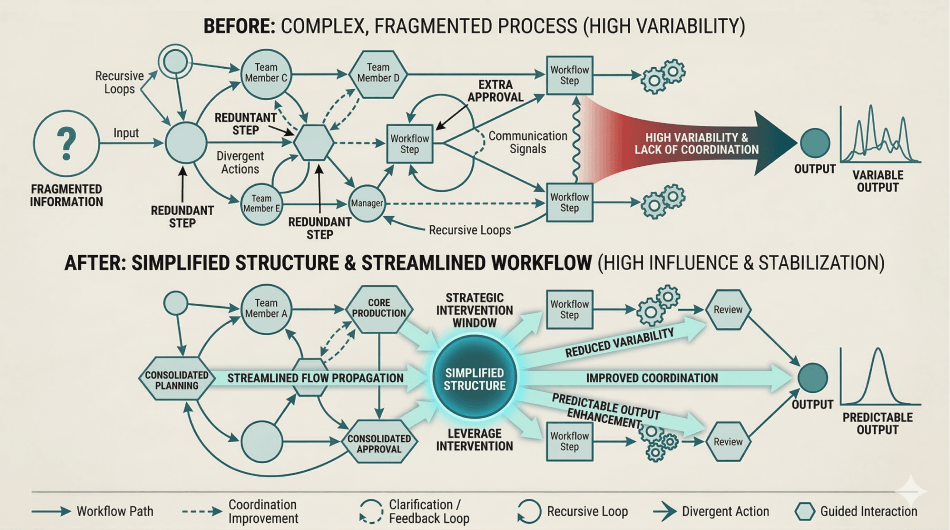
Systems Layer
Complexity in a system often accumulates through incremental adjustments.
Each added rule, step, or tool introduces new interactions between system components. As these interactions increase, the system requires more coordination and interpretation to function.
Structural complexity can appear in several forms:
- redundant process steps
- overlapping decision authority
- unnecessary approvals
- fragmented tools performing similar functions
- excessive information pathways
These elements increase the number of interactions required for the system to operate.
Simplification reduces these interactions by removing or consolidating structural elements. When fewer steps, signals, or decision points exist, system behavior becomes easier to coordinate and maintain.
Because many activities pass through the same processes, simplifying the structure can produce widespread improvements in efficiency and clarity.
Structural Translation
In simple terms, the more steps and rules a process has, the more opportunities there are for confusion and delay.
For example:
- removing an unnecessary approval step may accelerate the entire workflow
- consolidating information into one system may eliminate repeated searching
- simplifying a process may reduce the need for constant clarification
When the structure becomes simpler, people spend less time navigating the process and more time performing the work.
Structural Implication
When complexity accumulates unchecked, systems often respond with additional coordination.
Organizations may introduce:
- more meetings to synchronize activity
- more documentation to explain processes
- more oversight to manage inconsistencies
These responses add further layers to the system without reducing the underlying complexity.
As a result, the system becomes increasingly difficult to operate.
Without structural simplification, efficiency gains remain limited.
Leverage Insight
Complex systems often improve not through expansion, but through simplification.
AtomIQ recognizes that removing unnecessary structure can unlock significant leverage across the entire system.