
In many knowledge-based environments, the main limitation is not effort but cognitive capacity.
People must read information, organize ideas, draft explanations, make decisions, and coordinate with others. Each of these tasks consumes attention.
As workloads increase, cognitive load rises. Work slows not because the system lacks capability, but because human attention becomes the bottleneck.
The introduction of AI tools changes this dynamic by redistributing certain cognitive activities within the system.
Systems Layer
Human-AI collaboration can be understood as a distributed cognitive system.
Within this system, tasks are divided between human judgment and computational processing. AI systems can perform certain operations quickly, such as:
- pattern recognition
- text generation
- summarization
- classification
- structured reasoning across large datasets
These capabilities allow some cognitive activities to be outsourced from the human component of the system.
When AI handles high-volume or repetitive cognitive operations, human participants can focus on structural activities such as:
- defining goals
- selecting variables that matter
- interpreting results
- designing system improvements
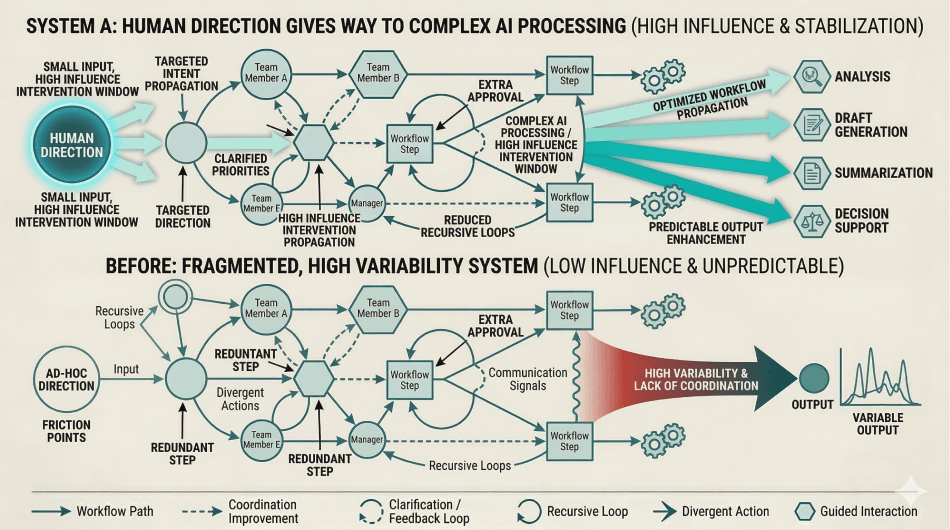
This redistribution creates leverage because a small human input can guide a large amount of computational work.
In this configuration, the human role shifts from performing tasks to shaping the system that performs them.
Structural Translation
In simple terms, AI tools allow people to multiply their thinking capacity.
Instead of performing every step manually, a person can:
- generate multiple drafts quickly
- summarize large amounts of information
- analyze patterns across many inputs
- test different ideas rapidly
A small instruction or prompt can trigger extensive work from the AI system.
The human contribution becomes the direction and structure of the task rather than the execution of each step.
Structural Implication
When AI tools are used without structural thinking, they often produce only small improvements.
People may use them for isolated tasks such as writing assistance or quick answers, while the overall workflow remains unchanged.
In these cases, AI acts as a convenience rather than a leverage point.
The real advantage emerges when AI becomes integrated into the system’s structure:
- generating structured outputs
- supporting decision processes
- automating repetitive cognitive work
- assisting with system analysis
When these integrations occur, the system’s overall capacity expands.
Leverage Insight
Human-AI collaboration creates leverage by redistributing cognitive work.
AtomIQ focuses on identifying the small human inputs — prompts, rules, and system designs — that allow AI to multiply the system’s thinking capacity.