
Sometimes the most important improvements are not obvious.
A team may spend time discussing large changes—new tools, new strategies, new structures—while the real opportunity for improvement sits quietly inside everyday activity.
A small point of friction. A repeated clarification. A step in a process that consistently slows everything down.
These details are easy to overlook because they appear minor. Yet careful observation often reveals that these small points are where meaningful change can begin.
Systems Layer
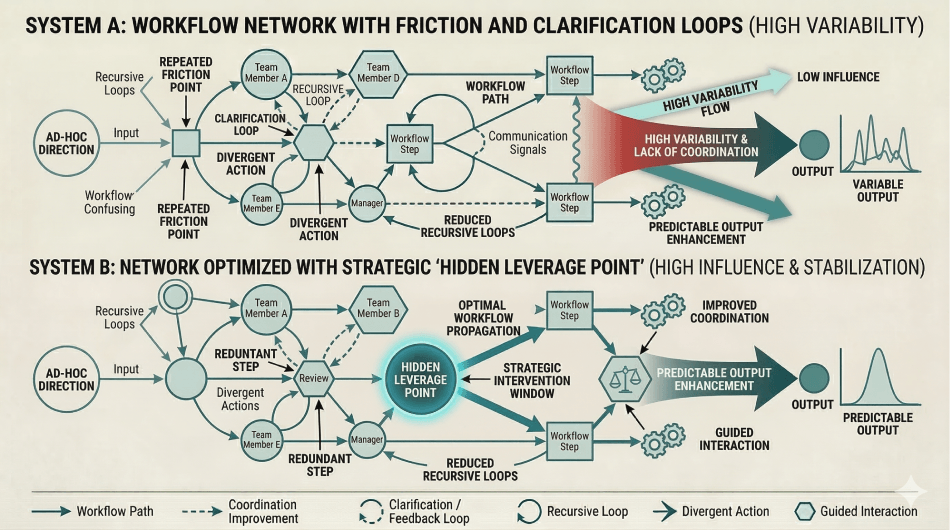
Leverage points in systems are not always visible through high-level analysis.
Because systems operate through repeated interactions between components, leverage often exists within small structural patterns that appear during daily operation.
These patterns can include:
- recurring delays at the same workflow step
- repeated clarification between the same roles
- frequent searches for the same information
- decisions repeatedly escalated to the same point
- small inconsistencies that propagate through the system
Each of these patterns indicates a structural node where the system’s behavior is being shaped.
If the node influences many interactions, even a small intervention can propagate through the system.
Identifying these nodes requires observation of how the system actually behaves rather than how it is formally designed.
Structural Translation
In simple terms, leverage points often hide inside the small frustrations people experience every day.
For example:
- if people repeatedly ask the same question, the system may lack a clear information source
- if work frequently pauses at the same step, the workflow may have an unclear handoff
- if decisions repeatedly escalate to one person, authority may not be distributed effectively
These small signals reveal where the system structure is influencing behavior.
Once the pattern is identified, a small adjustment can remove the friction.
Structural Implication
When systems overlook these hidden leverage points, improvement efforts often focus on large structural changes.
Organizations may introduce new platforms, redesign entire workflows, or launch major initiatives.
While these changes can sometimes help, they may miss the smaller structural nodes where behavior is actually being shaped.
As a result, the system may continue to experience the same friction despite substantial effort.
Without careful observation, leverage remains hidden.
Leverage Insight
Leverage often reveals itself through repeated patterns of friction or confusion.
AtomIQ focuses on observing these patterns closely, because small structural adjustments at these points can reshape the behavior of the entire system.