
Large improvements often appear sudden.
A system that once felt slow and difficult suddenly becomes smooth and effective. A team that struggled with coordination begins operating with clarity and speed.
From the outside, the change can seem dramatic.
But when examined closely, these shifts are often the result of many small improvements accumulated over time.
Systems Layer
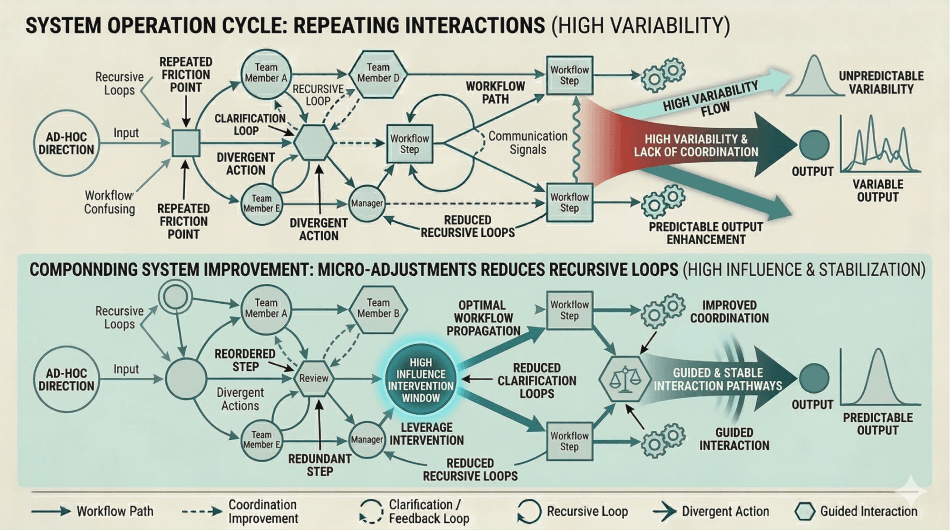
Systems evolve through repeated cycles of activity.
Each cycle includes actions, signals, decisions, and feedback that shape the system’s behavior. When a structural adjustment is introduced into these cycles, it influences every future repetition.
A single micro-improvement may produce only a small gain in one cycle.
However, because the system continues operating, the improvement affects each subsequent cycle as well.
This creates a compounding effect.
Examples of micro-improvements that compound include:
- removing a small friction point in a workflow
- clarifying a recurring decision rule
- improving the visibility of information signals
- refining coordination between roles
Each improvement slightly increases system efficiency. As these adjustments accumulate, the system’s behavior gradually shifts.
Over time, the combined effect becomes substantial.
Structural Translation
In simple terms, small improvements add up when they occur repeatedly.
If a process runs dozens or hundreds of times, even a small time-saving adjustment can produce significant gains.
For example:
- saving a minute in a daily task becomes hours over time
- clarifying one common question removes many repeated conversations
- improving one workflow step accelerates every future cycle of the process
Because systems repeat their activities, small improvements continue generating benefits long after they are introduced.
Structural Implication
When organizations focus only on large improvements, they may overlook opportunities for compounding gains.
Large initiatives often require significant coordination, resources, and time to implement.
Meanwhile, smaller adjustments remain unaddressed because their immediate impact appears limited.
Without attention to micro-improvements, systems miss the gradual accumulation of efficiency that leads to major shifts in performance.
Leverage Insight
System transformation often emerges from the accumulation of many small structural improvements.
AtomIQ emphasizes identifying micro-changes that compound across repeated system cycles, gradually shifting the system’s overall behavior.