

Sometimes a well-designed improvement fails to produce the expected results.
A team introduces a new process that appears efficient. A tool is implemented to streamline work. A workflow adjustment promises better coordination.
Yet despite the improvement, the system does not change significantly.
Often the reason is subtle: the intervention does not align with the system’s underlying direction.
Systems Layer
Every system operates with a governing orientation.
Orientation defines the direction toward which the system organizes its behavior. It is expressed through goals, incentives, decision priorities, and structural signals.
Components within the system adapt their behavior according to these signals.
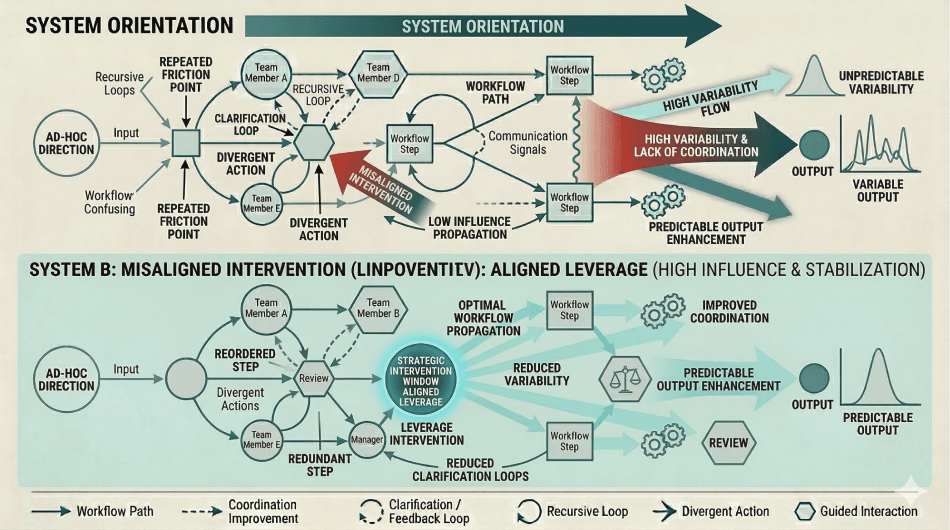
Leverage interventions work by influencing system structure. However, their effect depends on whether the intervention supports or contradicts the system’s orientation.
When leverage aligns with orientation:
- signals reinforce the intervention
- components naturally adopt the change
- system behavior shifts smoothly
When leverage conflicts with orientation:
- signals pull behavior in the opposite direction
- components resist or bypass the change
- the intervention struggles to propagate
In these cases, even structurally sound improvements produce limited results because the system’s directional signals override them.
Structural Translation
In simple terms, improvements only work when they support what the system is already trying to achieve.
For example:
- a productivity tool may fail if the system rewards speed over accuracy in a way that bypasses the tool
- a new process may be ignored if existing incentives encourage different behavior
- a workflow improvement may struggle if decision authority still operates under an older structure
The system follows the signals that define its direction.
If an intervention moves in a different direction, the system will naturally resist it.
Structural Implication
When organizations introduce improvements without considering orientation, systems often develop workarounds.
People may:
- bypass the new process
- ignore the tool
- continue using previous methods
- adapt the change to fit existing incentives
This behavior is not necessarily intentional resistance.
It is the system responding to its dominant signals.
Without alignment, leverage interventions lose their influence.
Leverage Insight
Leverage works best when it amplifies the system’s governing direction.
AtomIQ recognizes that structural interventions must align with orientation so that the system’s signals reinforce the change rather than oppose it.
