

Constraints are often seen as obstacles.
Limited time, restricted resources, rigid processes, or fixed requirements can feel like barriers that slow progress. The instinctive response is to try to remove or work around these limitations.
However, many effective systems do not eliminate constraints.
Instead, they use them.
When understood correctly, constraints can guide decisions, focus activity, and stabilize system behavior.
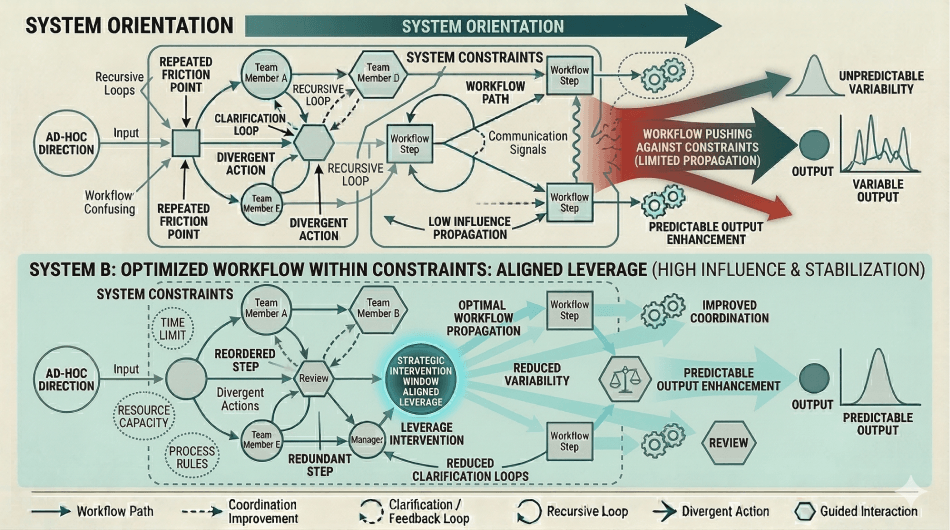
Systems Layer
Constraints define the boundaries within which a system operates.
They shape how components interact by limiting the range of possible actions. Examples include:
- resource availability
- time limits
- process rules
- capacity boundaries
- regulatory requirements
When systems attempt to ignore or bypass constraints, activity often becomes unstable.
Components repeatedly push against structural limits, leading to delays, rework, or inefficiencies.
However, when system design incorporates these constraints, they become organizing forces.
For example:
- capacity limits can guide workflow pacing
- time constraints can clarify decision priorities
- resource boundaries can encourage process efficiency
Instead of resisting the constraint, the system organizes itself around it.
This alignment reduces friction and allows activity to move more predictably through the system.
Structural Translation
In simple terms, working with constraints often produces better results than trying to overcome them.
For example:
- designing a workflow that fits within resource limits avoids constant overload
- structuring decisions around time constraints prevents endless discussion
- organizing tasks around capacity limits keeps the system stable
When the system respects its constraints, activity becomes easier to coordinate.
The constraint becomes a guide rather than a barrier.
Structural Implication
When organizations treat constraints purely as obstacles, they often create workarounds.
These may include:
- overloading resources
- bypassing processes
- compressing timelines unrealistically
- creating parallel efforts to compensate for limits
While these actions may temporarily increase output, they often introduce instability into the system.
Over time, the system experiences increased friction and reduced reliability.
Without incorporating constraints into the structure, efficiency improvements remain difficult to sustain.
Leverage Insight
Constraints are structural signals that define how a system can operate effectively.
AtomIQ focuses on aligning system design with these constraints so that they guide activity instead of resisting it.
Diagram Prompt
Create a clean systems diagram illustrating a system operating within constraints. Show boundaries labeled “System Constraints” such as “Time Limit,” “Resource Capacity,” and “Process Rules.” Inside the boundary, show workflows organized to move efficiently within these limits. Also illustrate an alternative path where activity pushes against the constraint and causes delays or instability. Use arrows to illustrate system flow. Style should be minimalistic with labeled nodes and a neutral background. Landscape ratio, blue style
Post Image Prompt
Create a conceptual illustration representing leveraging constraints instead of fighting them. Show a flowing system being guided smoothly through structured boundaries rather than colliding with them. Use symbolic elements such as channels directing flowing lines, rails guiding movement, or a mechanism operating efficiently within its designed limits. Style should be modern, clean, and suitable for a professional article header. Landscape ratio, blue style
