
Many improvement efforts focus on scale.
Organizations launch major initiatives, teams expand their activity, and individuals attempt to solve problems through increased effort. The assumption is that meaningful change requires large actions.
Yet experienced operators often notice a different pattern.
A small rule clarifies dozens of decisions. A simple template removes repeated explanations. A slight workflow adjustment eliminates ongoing delays.
These changes are small, but their effects spread widely through the system.
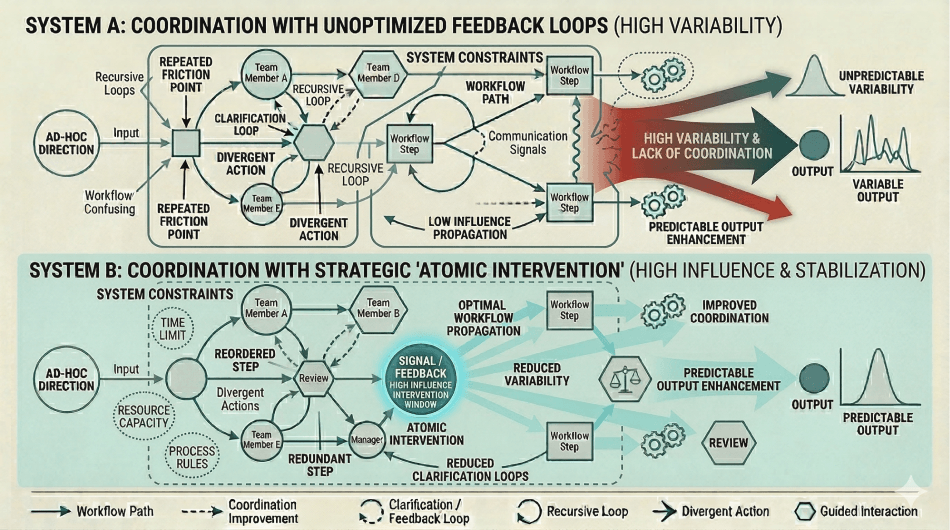
Systems Layer
AtomIQ is the discipline of identifying atomic structural interventions that produce disproportionate system effects.
Systems consist of interacting components guided by signals such as:
- decision rules
- information flows
- constraints
- feedback loops
- workflow structures
Within these structures, certain nodes influence many downstream interactions.
When an intervention modifies one of these nodes, the resulting change propagates through multiple parts of the system.
Because the intervention sits upstream of repeated activity, its impact multiplies over time and across participants.
This creates the appearance that a small action has produced a large outcome.
In structural terms, the intervention has activated leverage within the system.
Structural Translation
In simple terms, AtomIQ means focusing on the smallest change that improves many things at once.
Instead of trying to fix every problem individually, the focus shifts to identifying the structural point that influences many activities.
Examples include:
- defining a rule that removes repeated decisions
- centralizing information to eliminate constant searching
- adjusting a workflow step that affects every project
- introducing a feedback signal that improves future actions
Each of these interventions is small, but because it affects repeated behavior, the results compound across the system.
Structural Implication
Without a leverage-oriented approach, systems often attempt improvement through broad effort.
Organizations may introduce:
- large process redesigns
- additional oversight structures
- expanded coordination efforts
- extensive procedural documentation
These changes can increase activity without necessarily improving system behavior.
Without identifying structural leverage points, improvement efforts may remain expensive while producing limited results.
AtomIQ shifts attention from scale of effort to precision of intervention.
Leverage Insight
AtomIQ is the strategic discipline of applying the smallest possible action at the structural point where the system multiplies its effect.
The goal is not more effort.
The goal is precise intervention where the system itself does the work of amplification.
Diagram Prompt
Create a clean systems diagram showing a complex system with many interconnected nodes such as workflows, decisions, and information flows. Highlight a single node labeled “Atomic Intervention” that connects to several downstream components. Use arrows to show how a small change at this node propagates through the system and influences multiple outputs. Use a minimalistic systems-thinking style with clear labels and a neutral background. Landscape ratio, blue style
Post Image Prompt
Create a conceptual illustration representing AtomIQ as strategic leverage. Show a small precise control point or lever activating a large interconnected mechanism of gears or pathways. Use symbolic elements that visually communicate how a minimal action triggers widespread movement throughout the system. Style should be modern, clean, and suitable for a professional article header. Landscape ratio, blue style