
The Reinforcing Feedback Loop Model illustrates how certain system behaviors amplify themselves over time. In many systems, the results produced by an action influence future actions in ways that strengthen the original pattern. When this occurs, the system enters a reinforcing loop where change builds upon itself.
Unlike balancing systems that stabilize behavior, reinforcing systems accelerate it. Small changes can grow into large outcomes because each cycle of the loop increases the conditions that support the next cycle.
The diagram shows how an initial action produces system change, which generates measurable results. Those results produce feedback signals that influence future decisions, encouraging further actions that reinforce the original direction of change.
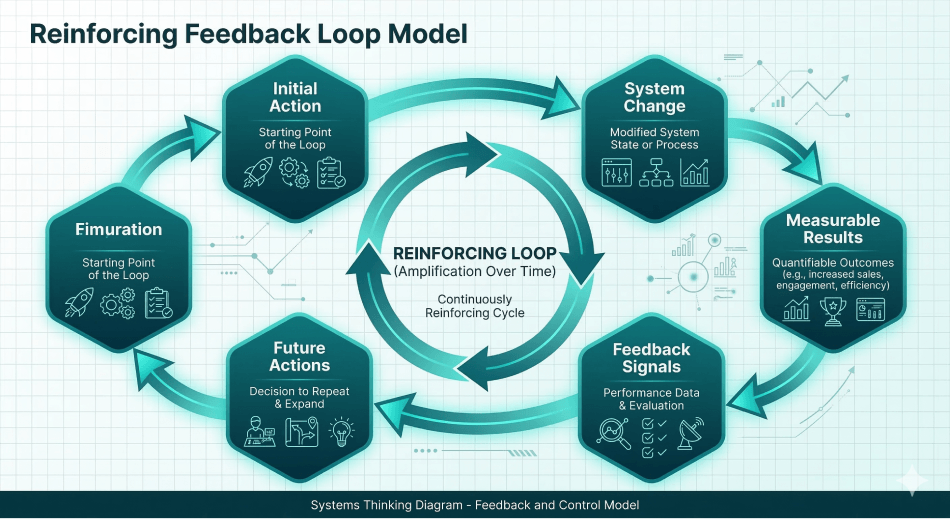
Initial Action
Every reinforcing loop begins with an initial action.
This action represents the starting point of the cycle. It may be a decision, an intervention, a change in behavior, or a new strategy introduced into the system.
The initial action does not necessarily appear significant at first. However, because the system contains a reinforcing structure, even small actions can initiate patterns that grow over time.
Examples might include launching a new product, adopting a new workflow, increasing marketing exposure, or introducing a process improvement.
System Change
The initial action produces a change in the system’s state.
System change represents the immediate effects of the initial action on system behavior or conditions. This change may modify processes, influence participants, or alter operational patterns.
At this stage, the system begins to shift from its previous equilibrium. The change sets the conditions for measurable outcomes to emerge.
Although the change may still appear modest, it begins altering how the system operates.
Measurable Results
System changes eventually generate measurable results.
These results represent the observable outcomes that follow the change in behavior or system structure. Examples may include increased performance, higher engagement, improved efficiency, or expanded adoption.
The key feature of reinforcing loops is that the results often strengthen the conditions that produced them. Positive results encourage participants to continue or expand the original behavior.
As results accumulate, the reinforcing pattern becomes more visible.
Feedback Signals
Measurable results generate feedback signals.
Feedback signals are the information that participants or system controllers observe when evaluating the system’s performance. These signals may include metrics, performance data, or qualitative observations.
When feedback signals indicate improvement or success, they reinforce confidence in the original action. Participants interpret these signals as confirmation that the system is moving in the right direction.
These signals therefore influence how the next decisions are made.
Future Actions
Based on feedback signals, participants make decisions about future actions.
In reinforcing systems, positive signals often encourage participants to repeat or expand the original action. This leads to increased investment in the same direction, further strengthening the initial pattern.
For example, successful marketing campaigns may receive additional funding, popular products may receive increased production, and effective practices may be adopted more widely across the organization.
Future actions therefore build upon the outcomes of previous cycles.
Reinforcing Loop
The center of the diagram represents the reinforcing loop itself.
Each cycle of action, change, results, feedback, and future decisions strengthens the pattern established by the initial action. As the loop continues, the system begins to amplify its own behavior.
This amplification may lead to rapid growth, accelerating improvement, or expanding influence. Many successful innovations, network effects, and learning processes follow this pattern.
Reinforcing loops are powerful because they compound change over time.
Structural Translation
Reinforcing loops appear in many types of systems.
In economic systems, successful products attract more customers, which increases visibility and generates even more demand. In social systems, popular ideas spread because each new adopter increases the likelihood of additional adoption.
In organizational systems, effective practices spread as teams observe successful results and replicate them across departments.
In technology systems, platform growth often accelerates as user participation increases network value.
In each case, the reinforcing loop drives cumulative expansion.
Structural Implication
Reinforcing systems can generate powerful positive outcomes, but they can also produce instability if left unchecked.
Positive reinforcing loops may produce rapid growth, innovation, and expanding capability. Negative reinforcing loops can amplify problems such as declining quality, rising errors, or loss of trust.
Because reinforcing loops amplify behavior, small changes early in the cycle can produce large long-term consequences.
Understanding these loops helps system designers identify patterns before they accelerate beyond control.
Leverage Insight
The most effective way to influence reinforcing systems is to intervene early in the cycle.
Because each loop amplifies previous results, early actions have a disproportionately large impact on future outcomes. Strengthening positive loops can accelerate beneficial growth, while interrupting negative loops can prevent escalating problems.
By identifying the signals and decision points that drive reinforcing behavior, system designers can guide how amplification unfolds.
Reinforcing loops demonstrate that systems do not simply change linearly. Under the right structural conditions, change can compound and reshape the entire system over time.