

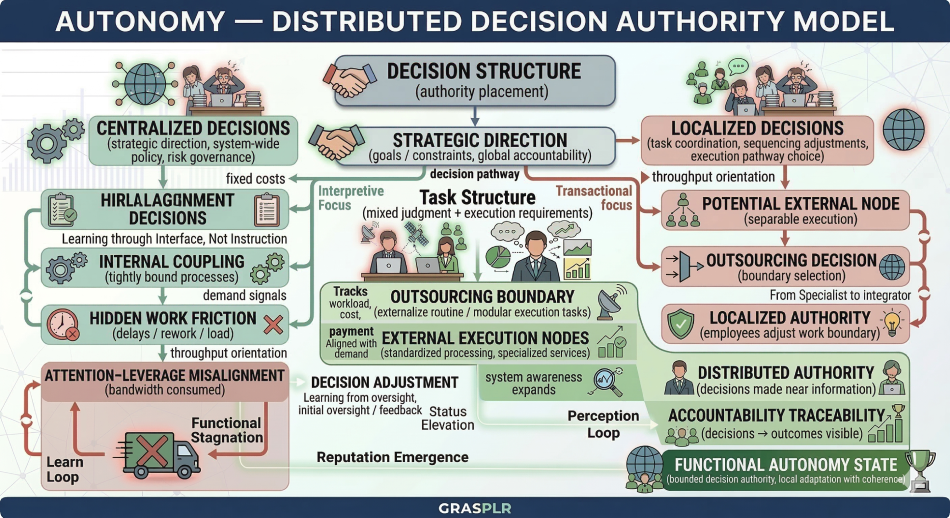
Autonomy inside organizations is often discussed as a cultural attribute: trust, empowerment, freedom. These terms point in the right direction, but they obscure a more concrete mechanism. Autonomy emerges when decision authority is placed close to the information required to make those decisions.
A simple observation helps ground this. In any coordinated activity, there are choices that affect the whole and choices that affect only a part. When all choices are routed through a central point, coordination slows and local context is lost. When every choice is made locally without constraint, coherence dissolves. Functional autonomy sits between these extremes.
Outsourcing reshapes where this balance lands.
Decision Space, Not Independence
Autonomy does not mean independence from the system. It means having a defined decision space within it.
When employees are required to execute tasks end to end—regardless of whether those tasks require their judgment—their decision space narrows. Much of their time is spent following procedures or resolving peripheral issues. Choices that matter are crowded out by choices that merely maintain flow.
Outsourcing changes this by removing certain categories of decisions from the employee’s workload entirely. Routine execution, specialized processing, or volume-heavy tasks are handled elsewhere. What remains are decisions that require contextual understanding, prioritization, and integration.
Autonomy increases not because employees are told they are empowered, but because their remaining decisions actually matter.
The Road Trip Analogy, Structurally
The road trip analogy is useful if interpreted structurally rather than socially. A journey has a destination, constraints, and shared risks. Within that framework, some decisions benefit from central coordination, while others are better made locally.
Allowing passengers to choose music, stops, or pacing does not undermine the trip. It improves it by distributing micro-decisions to those closest to their effects. The driver retains responsibility for navigation and safety, but does not need to manage every preference.
Outsourcing functions similarly. Leadership retains strategic direction and accountability, while employees gain control over how their work environment and execution pathways are shaped. This shared control reduces friction without sacrificing alignment.
Autonomy as a Coordination Outcome
In decentralized organizational structures, autonomy often appears alongside outsourcing. This is not coincidental.
When parts of the system are handled externally, internal teams must coordinate rather than execute everything themselves. Coordination requires judgment: deciding what to delegate, how to specify work, and how to evaluate outcomes.
These decisions cannot be fully centralized without slowing the system. They must be made where context is richest. As a result, employees are granted genuine decision authority—not symbolic choice, but operational control within boundaries.
Autonomy here is an outcome of coordination demands.
Constraints That Enable Freedom
A common misconception is that autonomy requires removing constraints. In practice, autonomy requires clear constraints.
Outsourcing clarifies these constraints by making interfaces explicit. Inputs, outputs, timelines, and quality thresholds must be defined for external work to function. Once defined, internal teams can operate freely within those bounds.
This reduces ambiguity. Employees know what they own, what they can decide, and what success looks like. The system becomes easier to navigate, even as decision-making becomes more distributed.
Autonomy increases because uncertainty decreases.
Autonomy and Accountability
Another structural effect of outsourcing is tighter coupling between autonomy and accountability. When employees decide what to outsource and how to integrate it, outcomes are more clearly traceable to decisions.
This traceability discourages performative autonomy while supporting responsible autonomy. Decisions are not made for expression, but for system performance. Feedback arrives quickly, and adjustments follow.
Over time, this produces a workforce that is comfortable making decisions within limits, rather than waiting for permission or acting without alignment.
Autonomy as System Design
Seen this way, autonomy is not something to grant or encourage directly. It is something that appears when decision rights, task boundaries, and coordination mechanisms are well designed.
Outsourcing contributes by reshaping these elements. It removes low-judgment decisions from internal roles and amplifies the importance of the decisions that remain. Employees experience autonomy because their actions have visible impact.
The system becomes both more distributed and more coherent at the same time.
