

In many organizations, outsourcing is discussed in financial terms: cost reduction, variable capacity, efficiency gains. Yet when you look closely at how outsourcing actually operates inside a company, a different pattern becomes visible. The most consequential effects are not financial. They are structural.
Consider a familiar scene: a team where individuals are allowed to decide which tasks to keep close and which to hand off. Some work remains tightly coupled to their judgment and context. Other work is deliberately pushed outward to specialists, tools, or temporary collaborators. What changes first is not output volume, but attention.
Attention is a scarce resource inside any system. Where it is directed determines what can be noticed, improved, or corrected. Outsourcing alters the distribution of attention by changing who is responsible for what, and how tightly different activities are bound together.
In this sense, outsourcing is less a procurement tactic and more a boundary-setting mechanism.
What Becomes Visible When Tasks Move
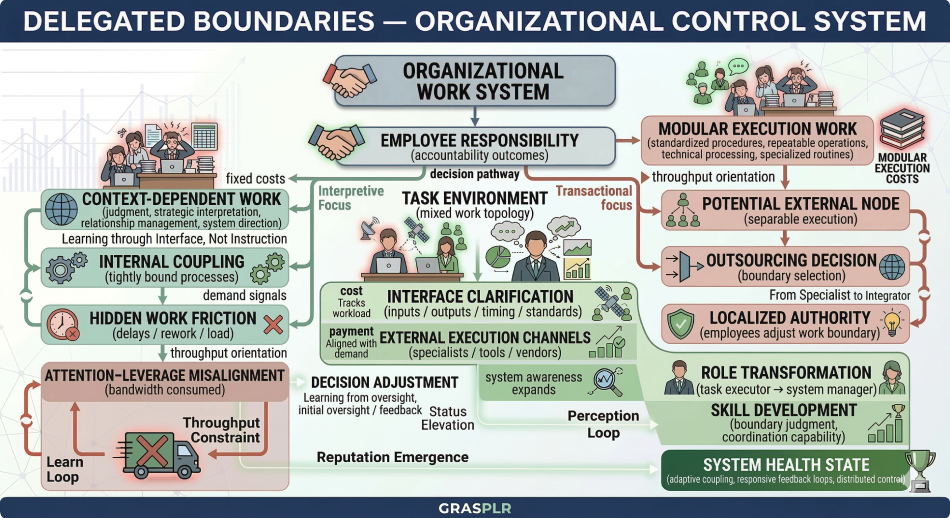
When tasks are retained internally, their friction is often absorbed silently. Delays, rework, and inefficiencies blend into daily routines. Once a task is outsourced, its interfaces must be named. Inputs, outputs, timing, and quality expectations are forced into visibility.
This shift exposes hidden structure. Employees begin to see which parts of their work genuinely require their judgment and which are essentially modular. The system starts differentiating between work that depends on context-rich decision-making and work that can be standardized without loss.
The act of outsourcing, then, does not simply remove work. It clarifies the topology of work.
This clarification has secondary effects. Employees who control outsourcing decisions begin to experience their role less as task execution and more as system coordination. They are no longer only producing outcomes; they are shaping the pathways through which outcomes are produced.
Authority Without Centralization
In many companies, authority is centralized while responsibility is distributed. This creates a mismatch. People are held accountable for outcomes but have limited ability to shape the conditions that produce them.
When employees are given discretion to outsource specific tasks, a subtle rebalancing occurs. Authority is not expanded in a sweeping sense, but localized. Individuals gain control over the immediate boundaries of their work system.
This does not eliminate constraints. Budgets, standards, and oversight still exist. But within those constraints, employees can adjust coupling strength: deciding when to rely on external expertise, when to internalize learning, and when to temporarily extend capacity.
The result is not autonomy in the abstract, but adaptive control. Employees are able to respond to workload variation, skill gaps, and time pressure without escalating every decision upward. Feedback loops shorten. Adjustments happen closer to where information is richest.
Outsourcing as a Load-Balancing Mechanism
From a systems perspective, outsourcing functions like load balancing in a network. When demand spikes or complexity increases, work can be rerouted rather than allowed to overload a single node.
Importantly, this only works when the routing decision is made locally. Centralized outsourcing departments often optimize for cost or compliance, but they lack the situational awareness to balance cognitive load effectively at the individual level.
When employees choose how and when to outsource, the system distributes pressure more evenly. This reduces burnout not by reducing total work, but by preventing sustained overload in any one part of the system.
Over time, this stabilizes performance. Variability is absorbed at the edges rather than accumulating at the center.
Skill Formation Through Boundary Management
There is an assumption that outsourcing hollowes out internal capability. Sometimes it does. But this depends on how boundaries are managed.
When employees actively engage with external specialists, they are exposed to alternative methods, tools, and standards. They learn where their own expertise adds value and where it does not. Skill development shifts from task repetition to judgment refinement.
The metaphor here is not replacement, but scaffolding. External expertise temporarily supports the structure while internal capacity reorganizes around higher-level coordination, integration, and decision-making.
This reframes professional growth. Advancement no longer depends solely on doing more tasks, but on managing more complex systems of work.
From Efficiency to System Health
Seen this way, outsourcing is not primarily about speed or savings. It is about system health.
Healthy systems have clear boundaries, adjustable coupling, and responsive feedback loops. They allow components to specialize without becoming isolated. They enable local adaptation without losing global coherence.
When employees are empowered to outsource thoughtfully, the organization becomes more legible to itself. Workflows clarify. Bottlenecks surface earlier. Decision rights align more closely with information flow.
The outcome is not a motivational uplift, but a structural one. Engagement emerges as a side effect of coherence, not as a target to be engineered.
