

Outsourcing is often introduced as a financial decision: lower costs, variable capacity, operational efficiency. These effects are real, but they are not the most structurally important ones. The deeper impact of outsourcing appears in how it reshapes what employees are able to focus on and how effectively their effort translates into outcomes.
A useful place to begin is with a simple observation. In most organizations, employees are not constrained by willingness or effort. They are constrained by how their attention is consumed. When skilled people spend significant time on work that does not require their judgment, the system underutilizes its most valuable capability.
Outsourcing intervenes at this point.
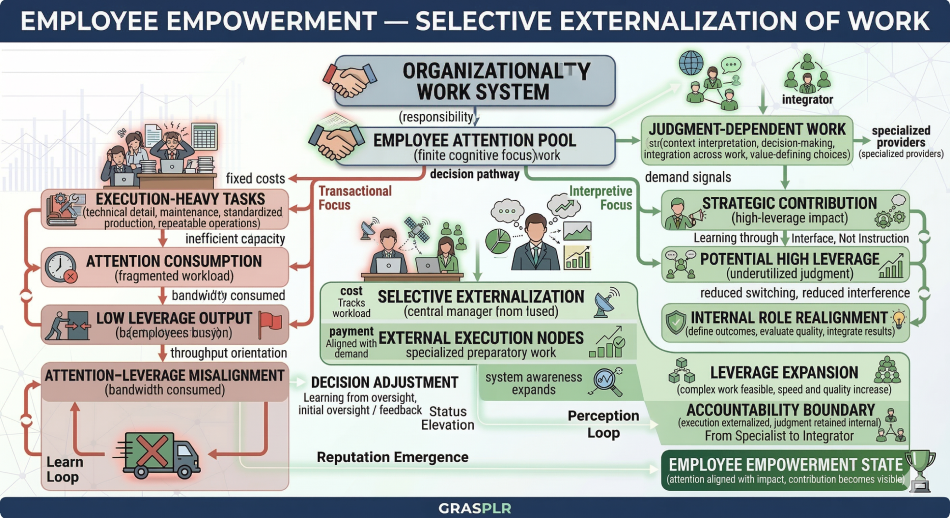
Workload Is Not the Same as Leverage
Employees often appear “busy” while producing limited leverage. They handle execution-heavy tasks, technical details outside their core expertise, or maintenance work that crowds out strategic thinking.
Outsourcing does not remove work from the system. It redistributes it. Tasks that can be specified, standardized, or executed independently move outward. What remains internal is work that depends on context, integration, and decision-making.
This redistribution increases leverage. Employees are no longer responsible for everything required to produce an outcome, but for the parts where their judgment makes the largest difference.
Empowerment follows because contribution becomes clearer and more consequential.
Tools Change What Work Is Possible
The carpenter analogy works when treated as a structural comparison. A better tool does not make the carpenter more motivated. It changes what level of precision and speed are achievable without additional strain.
Outsourcing functions as an organizational tool in the same way. It expands what employees can realistically accomplish within the same time and cognitive limits. Teams can take on more complex projects, respond faster to change, and operate at a higher level of abstraction.
Importantly, this does not require employees to know how every outsourced task is executed. Their role shifts toward defining outcomes, evaluating quality, and integrating results.
The nature of the job changes, even if the job title does not.
Focus Enables Speed and Quality
In startup environments, this effect is especially visible. Small teams are often forced to juggle design, execution, troubleshooting, and promotion simultaneously. Progress slows not because of indecision, but because attention is constantly divided.
By outsourcing technical execution or specialized tasks, internal teams can focus on coherence: product vision, user experience, and market fit. Decisions improve because they are made within a stable context rather than between interruptions.
Speed increases as a side effect of reduced fragmentation. Quality improves because fewer compromises are made under pressure.
Risk Reveals What Matters
Outsourcing also exposes an important boundary: what should never be delegated lightly.
Failures in outsourcing are rarely about the act itself. They arise when organizations externalize work that embodies their values, accountability, or identity without adequate oversight. Ethical standards, quality expectations, and responsibility chains become unclear.
From a systems perspective, this is not an argument against outsourcing. It is a signal about boundary placement.
Empowering employees through outsourcing works when judgment, responsibility, and value-defining decisions remain internal. Execution can move outward, but accountability cannot.
Empowerment Without Abdication
A common misconception is that empowering employees through outsourcing means loosening control. Structurally, the opposite is true.
Effective outsourcing requires clearer specifications, better feedback loops, and more deliberate monitoring. Employees who are empowered to outsource must articulate what success looks like and evaluate whether it has been achieved.
This strengthens accountability rather than weakening it. Decisions are visible. Outcomes are traceable. Learning accelerates because cause and effect are easier to observe.
Empowerment becomes operational, not rhetorical.
Why Organizations Choose This Path
Organizations that empower employees through outsourcing tend to converge on a similar realization: growth depends less on adding effort and more on redesigning how effort is applied.
Outsourcing allows the system to protect scarce internal resources—attention, judgment, and integration—while still accessing execution capacity and specialized expertise. Employees operate closer to their highest-value contribution.
The result is not simply efficiency. It is a form of structural clarity that allows people to work in ways that feel both effective and sustainable.
