
Productivity is often described as doing more in less time. But in organizational settings, sustained productivity is less about speed and more about fit: the alignment between tasks, skills, and attention.
A useful observation comes from environments where output depends on care rather than force. In a well-managed garden, growth does not come from the gardener performing every action personally. It comes from arranging conditions so that each plant receives what it needs, when it needs it. Effort is distributed. Interventions are selective.
Organizations operate under similar constraints.
When employees are responsible for a wide mix of tasks—some requiring judgment and creativity, others routine and repeatable—the system begins to blur distinctions that matter. Time is fragmented. Attention is diluted. High-skill work competes with maintenance work for the same cognitive resources.
Outsourcing changes this distribution.
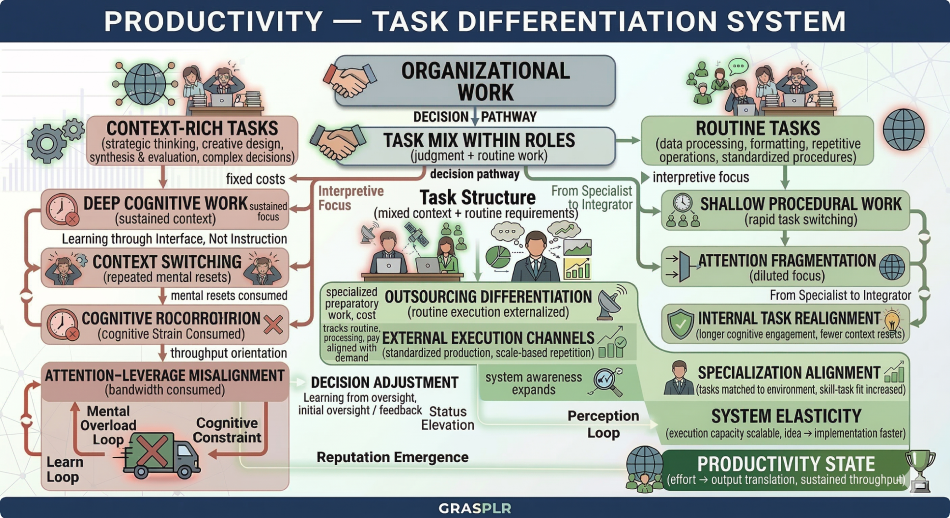
Productivity and Cognitive Load
At a structural level, productivity is limited by cognitive load. Each additional task, even a small one, imposes switching costs. When employees move repeatedly between deep, context-rich work and shallow, procedural tasks, throughput declines even if total effort increases.
Outsourcing reduces this load by separating task types across different parts of the system. Routine or highly standardized work can be handled externally, allowing internal teams to operate with longer stretches of uninterrupted focus.
The immediate effect is not acceleration, but continuity. Work proceeds with fewer resets. Decisions are made within a stable context. Errors caused by distraction decrease.
Over time, this continuity compounds into higher output with less strain.
Specialization Without Fragmentation
A common concern is that outsourcing fragments work. In practice, fragmentation occurs when boundaries are unclear, not when they exist.
When tasks are outsourced along clean interfaces—clear inputs, outputs, and quality criteria—specialization increases without introducing confusion. Internal teams know what they are responsible for, and external partners know what is expected.
This clarity allows each part of the system to optimize locally without undermining the whole.
In industries like fashion, this pattern is easy to observe. Design, branding, and market sensing are tightly coupled to trend awareness and creative judgment. Manufacturing, by contrast, relies on scale, repeatability, and process discipline. When these functions are separated structurally, each can evolve at its own pace.
Productivity increases not because anyone works harder, but because each activity is performed in an environment suited to its constraints.
Time-to-Market as a Structural Outcome
Another dimension of productivity is timing. How quickly can an organization move from idea to execution?
When internal teams are overloaded with execution details, new initiatives wait. Concepts accumulate faster than they can be realized. This creates the illusion of low productivity, even when people are busy.
Outsourcing execution-heavy components can shorten these delays. Internal teams retain responsibility for direction and integration, while external capacity absorbs volume. The system gains elasticity.
This elasticity matters in competitive environments where timing, not just quality, determines success. Faster iteration does not come from urgency, but from having capacity available at the right layer of the system.
Productivity Emerges from Alignment
Seen this way, productivity is not a personal trait or a cultural value. It is an emergent property of how work is structured.
When employees spend most of their time on tasks that match their skills and decision authority, output improves naturally. When they are shielded from avoidable interruptions and mismatched responsibilities, effort translates more directly into results.
Outsourcing contributes by refining these alignments. It helps organizations distinguish between work that benefits from internal context and work that benefits from external scale or specialization.
The garden metaphor holds as long as it remains descriptive: growth depends less on intensity of effort and more on how care is distributed across the system.