
Companies often talk about “brand representation” as something shaped by messaging, guidelines, or training. But how an organization is actually represented—to customers, partners, and the public—is more directly influenced by how work is structured internally.
A useful analogy is a team-based environment where performance depends on coordination rather than individual effort alone. Each role exists for a reason, and overall success depends less on everyone doing everything, and more on each role being performed well. When roles are blurred or overloaded, performance degrades even if commitment remains high.
The same pattern appears in organizations.
When employees are responsible for too many peripheral or administrative tasks, their ability to perform their core role weakens. Attention is split. Quality becomes uneven. The outward-facing expression of the company—its service, communication, and decision-making—reflects this internal diffusion.
Outsourcing reshapes this dynamic by tightening role boundaries.
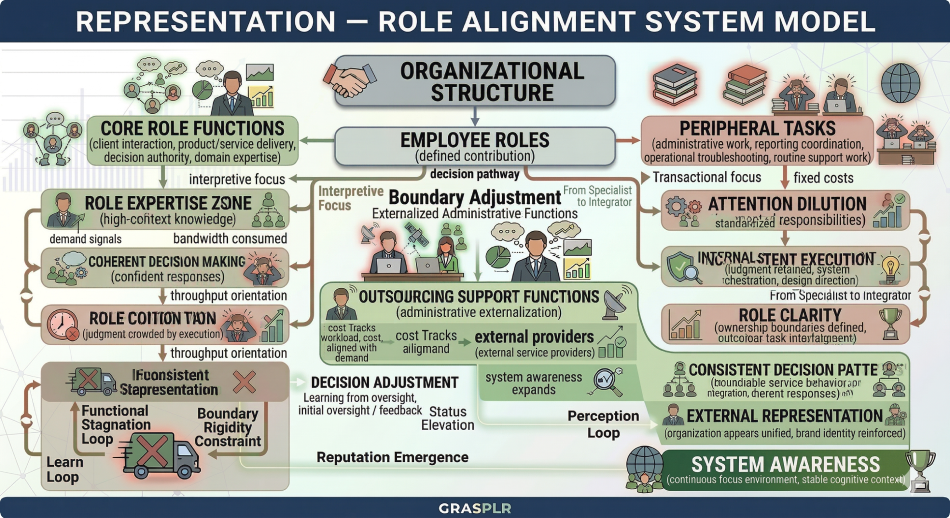
Role Clarity and External Perception
Representation is not only about what employees say or produce, but about how consistently and coherently they act. Customers infer the character of a company from repeated interactions: how reliably issues are handled, how confidently decisions are made, and how clearly responsibilities are owned.
When employees are allowed to outsource tasks that do not require their direct judgment, their internal role becomes more coherent. They spend more time operating within the domain where they have authority and expertise.
This coherence shows up externally. Employees speak with greater clarity. Decisions feel less tentative. Responses are more consistent because they are less encumbered by unrelated demands.
The company appears more unified, not because of tighter control, but because internal roles are less fragmented.
Coordination Without Dilution
In many organizations, representation suffers not from lack of effort, but from dilution of responsibility. Employees act as partial representatives across too many domains. They manage customer interactions while juggling internal reporting, administrative coordination, and operational troubleshooting.
Outsourcing support functions reduces this dilution. Back-office and operational work is handled elsewhere, allowing frontline and core teams to concentrate on activities that define the organization’s identity.
This does not isolate employees from the rest of the system. Instead, it clarifies interfaces. Employees know where to route tasks, how to escalate issues, and what they are accountable for.
Clear interfaces reduce internal friction. Reduced friction improves how the organization presents itself under pressure.
Focus and Brand Expression
In the case of a luxury-focused organization, brand expression depends heavily on consistency, quality, and attention to detail. When internal teams are preoccupied with administrative or logistical burdens, these qualities erode subtly.
Outsourcing administrative and support functions allows creative and strategic teams to remain focused on the work that carries symbolic and economic weight. Design decisions receive more care. Product standards are enforced more consistently. Messaging aligns more closely with actual offerings.
Customers experience this as authenticity. The company appears to “know who it is,” not because of branding exercises, but because its internal attention is concentrated where identity is produced.
Representation as System Output
Seen systemically, representation is not something employees add on top of their work. It is an output of how roles, responsibilities, and boundaries are arranged.
Outsourcing contributes by removing noise from key roles. Employees are not made more representative through training or exhortation, but through structural conditions that allow them to perform their primary function well.
The sports team metaphor holds if treated carefully: performance improves when each role is supported by the right surrounding structure. Representation improves for the same reason.