
Employee satisfaction and customer satisfaction are often discussed as separate outcomes, managed through different programs, metrics, or initiatives. One is handled by HR, the other by customer experience teams. Yet in practice, both tend to rise or fall together, shaped by the same underlying structures.
A common source of strain appears when employees spend a large portion of their time on work that feels misaligned with their skills or judgment. Routine, repetitive, or administratively dense tasks absorb attention that could otherwise be used for problem-solving, learning, or meaningful interaction. Over time, this mismatch erodes engagement—not through burnout alone, but through a quiet sense of underutilization.
Outsourcing changes this pattern by altering what remains inside the role boundary.
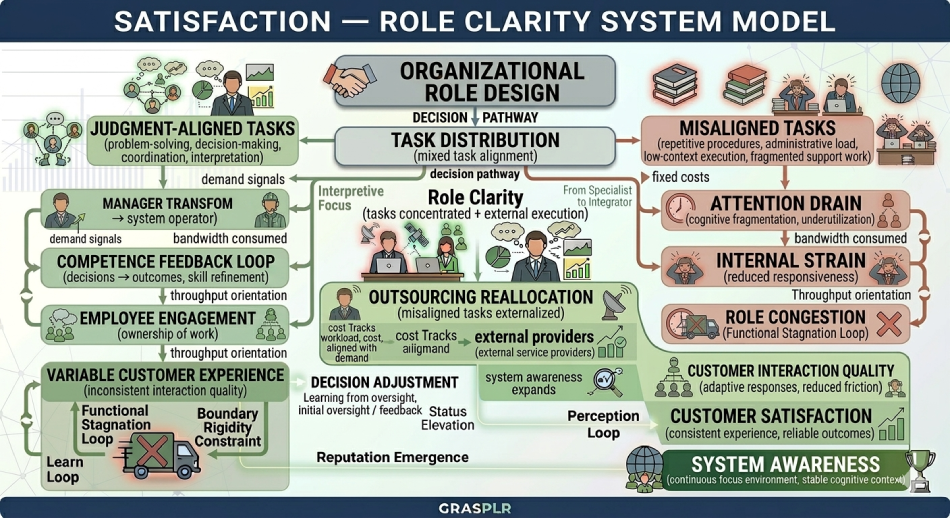
Satisfaction and Task Fit
From a systems perspective, satisfaction is strongly influenced by task fit: the degree to which daily work aligns with an individual’s capabilities and decision authority.
When employees are able to outsource tasks that are procedural or time-consuming, their role shifts. The remaining work tends to involve interpretation, prioritization, and coordination—activities where personal judgment matters. This does not eliminate effort, but it changes its character.
Work that requires judgment provides clearer feedback. Employees can see the effects of their decisions, refine their approach, and develop skill over time. This feedback loop supports a sense of competence and ownership without needing motivational framing.
Satisfaction, in this context, is not an emotional outcome. It is a structural one.
The Transmission Mechanism to Customers
Customer satisfaction is downstream from how work is experienced internally. This is not because happier employees are more cheerful, but because they have more cognitive and emotional bandwidth available during customer interactions.
When internal roles are overloaded, customer-facing moments are compressed. Interactions become transactional. Small issues are escalated unnecessarily or handled defensively. None of this requires poor intent; it follows naturally from constrained attention.
By contrast, when employees are less burdened by peripheral tasks, they can respond to customers with greater presence and flexibility. They notice nuances. They adapt responses rather than following scripts rigidly. Problems are resolved closer to their source.
The system becomes smoother because fewer interactions are distorted by internal friction.
Learning as a Side Effect
Another structural effect of outsourcing is exposure. When employees coordinate with external specialists or service providers, they encounter different methods, tools, and standards. This interaction can expand their understanding of how work is done beyond the boundaries of the organization.
Importantly, this learning is contextual. It arises from real coordination needs rather than formal training. Employees learn what to specify, what to verify, and where quality risks emerge. These are transferable skills that strengthen internal capability over time.
As roles become richer in judgment and coordination, employees experience growth without needing role changes or promotions. This contributes to stability and continuity, which customers experience as reliability.
Flexibility Without Instability
Outsourcing also affects how organizations respond to change. When workload fluctuates or new demands appear, employees with access to external capacity can adapt without immediate overload.
This flexibility reduces stress responses inside the system. Instead of absorbing all variability internally, the organization buffers it at the edges. Employees remain composed under pressure, and customers encounter consistency rather than strain.
Satisfaction on both sides increases not because conditions are perfect, but because the system absorbs variation more gracefully.
Satisfaction as an Emergent Property
Seen through this lens, employee and customer satisfaction are not separate targets to optimize. They are emergent properties of how roles, tasks, and boundaries are designed.
Outsourcing contributes by clarifying what work truly belongs inside the organization and what can be handled elsewhere with minimal loss of coherence. When this distinction is well made, internal roles become more meaningful and external interactions become more reliable.
The result is not a culture shift or a motivational surge, but a quieter form of alignment that customers and employees both experience as quality.