
Skill growth inside organizations is often treated as a training problem: courses, certifications, or internal rotations. These mechanisms matter, but they overlook a quieter and often more durable source of learning—the structure of everyday work and who that work is done with.
An observable pattern appears when employees operate within tightly closed systems. Skills deepen in familiar directions, but breadth develops slowly. Over time, teams become highly competent within a narrow band of methods and tools. This is efficient, but it also limits adaptability when conditions change.
Outsourcing alters this learning environment.
A useful metaphor is cultivation, used carefully. Growth does not occur because effort is increased, but because the environment allows new inputs. When employees work alongside or coordinate with external specialists, their skill boundaries become more permeable.
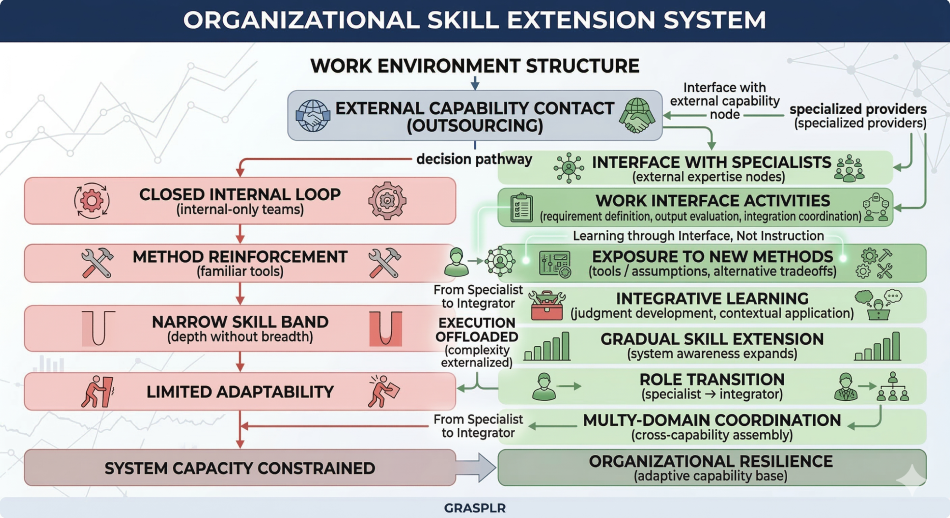
Learning Through Interface, Not Instruction
When organizations outsource parts of their work, employees must define requirements, review outputs, and integrate results. Each of these steps requires articulation of intent and evaluation of quality.
This interaction creates learning without formal teaching. Employees encounter unfamiliar tools, techniques, and assumptions through real work rather than abstract training. They learn what external experts consider standard, what tradeoffs they make, and how they frame problems differently.
These lessons tend to stick because they are immediately relevant. They arise in response to concrete needs, not hypothetical scenarios.
Skill extension here is not additive in the sense of “more skills,” but integrative. Employees develop better judgment about when and how different approaches apply.
Expansion Without Overload
One risk in skill development is overload. When employees are asked to both maintain existing responsibilities and acquire new capabilities simultaneously, learning competes with delivery. Stress increases, and neither objective is met well.
Outsourcing mitigates this by offloading execution while exposing employees to new domains at the coordination level. They do not need to master every detail immediately. Instead, they observe, question, and selectively internalize what is useful.
This allows skills to extend outward gradually, anchored to real constraints. Over time, employees become capable of handling more complex work not because they trained harder, but because their role now includes broader system awareness.
From Specialist to Integrator
As employees’ skill sets expand through external collaboration, their role often shifts subtly. They move from being pure specialists to integrators—people who can connect different capabilities into a coherent whole.
This is particularly visible in fields like marketing or software development, where tools and practices evolve quickly. Employees who have worked with external experts gain fluency across domains. They can coordinate campaigns that span platforms, or design systems that combine multiple technologies.
The value of this integrative skill is that it scales. The organization becomes capable of offering more complex services without requiring every capability to be fully internalized.
Clients experience this as sophistication and adaptability.
Skill Extension as System Capacity
At the organizational level, skill extension is less about individual advancement and more about system capacity. When employees understand a wider range of tools and methods, the organization can take on work that was previously out of reach.
Importantly, this does not require abandoning focus. Core competencies remain central. Outsourcing simply provides access points where learning can occur without destabilizing existing operations.
The tree metaphor holds if kept grounded: growth depends on sustained contact with nourishing inputs, not on sudden transformation. Skills develop through repeated exposure, feedback, and integration.
Extension Without Replacement
A common fear is that outsourcing replaces internal skill development. In practice, replacement occurs when employees are excluded from interaction. Extension occurs when they are involved at the boundary.
When employees remain responsible for framing problems, evaluating results, and integrating outcomes, their skills grow even as execution happens elsewhere. The organization gains both external capability and internal learning.
Over time, this combination produces resilience. Skills are not static assets, but evolving capacities shaped by the structure of work.