

Most people spend their lives reacting to visible events.
• Stress
• Confusion
• Delays
• Overthinking
• Conflict
• Burnout
• Disorganization
• Uncertainty
But visible events are rarely the system.
They are the output of deeper hidden structures operating underneath awareness.
The Unseen Systems Collection was created to help ordinary people develop a completely new way of seeing.
Not through complicated theory
Not through academic jargon
Not through technical overwhelm
But through structured systems literacy designed to make hidden structure visible.
It is a complete interpretive framework for learning how reality organizes itself beneath the surface.
Inside this collection, you will learn how to:
• Recognize hidden systems
• Trace flow and relationships
• Understand bottlenecks and feedback
• Identify invisible behavioral structures
• Interpret diagrams and workflows
• Analyze systems independently
• Redesign systems intentionally
observe repeating patterns across life, work, technology, communication, and human behavior
The goal is simple:
To help you stop reacting only to surface events… and begin understanding the structures producing them.
These three books form the philosophical and structural entry point into the entire ecosystem.

A systems-based human framework exploring the interaction between:
• Thinking
• Emotion
• Movement
• Instinct
• Energy
This book transforms human behavior from something random and emotional into something structural, observable, and mappable.
You will explore:
• Anxiety as unresolved activation
• Procrastination as blocked initiation
• Burnout as depleted capacity
• Overthinking as cognitive saturation
Instead of treating behavior as isolated symptoms, the system becomes visible.
“The system is already operating. This framework makes it visible.”
GRASPLR Kit Included

This book reveals how systems communicate silently through:
• Structure
• Arrangement
• Sequence
• Constraint
• Flow
Words are treated not as descriptions… but as compressed systems.
You will learn:
• Why structure directs behavior
• How flow acts like sentence construction
• Why constraints shape movement
• How systems issue “unseen instructions”
• Why naming something is not the same as understanding it
“Words are not the system. They are compressed representations of it.”
GRASPLR Kit Included

Each card is rebuilt as a systems state model using:
• Source
• Operator Output
• Consequence
The collection transforms symbolic cards into structured transition systems.
You will explore:
• System progression
• Feedback states
• Transformation cycles
• Alignment systems Collapse and renewal
• Controlled movement
• Structured change
“The cards do not describe events. They describe how systems behave under specific conditions.”
GRASPLR Kit Included
After the foundational trilogy, the collection expands into a complete systems literacy framework.
Included…

A practical introduction to:
• Systems
• Flow
• Bottlenecks
• Feedback
• Dependencies
• Hidden structure
GRASPLR Kit Included + 20 PLR Article Pack
Free and available after purchasing your 2nd Product

A beginner-friendly interactive workbook containing:
• Foundational systems vocabulary
• Observation exercises
• Matching exercises
• Real-world spotting activities
• Guided reflection prompts
GRASPLR Kit Included + 20 PLR Article Pack
Free and available after purchasing your 3rd Product

Learn how to calmly interpret:
• Flowcharts
• Process maps
• Hierarchy diagrams
• Loop systems
• Data flow diagrams
• Fishbone diagrams
GRASPLR Kit Included + 20 PLR Article Pack
Free and available after purchasing your 4th Product
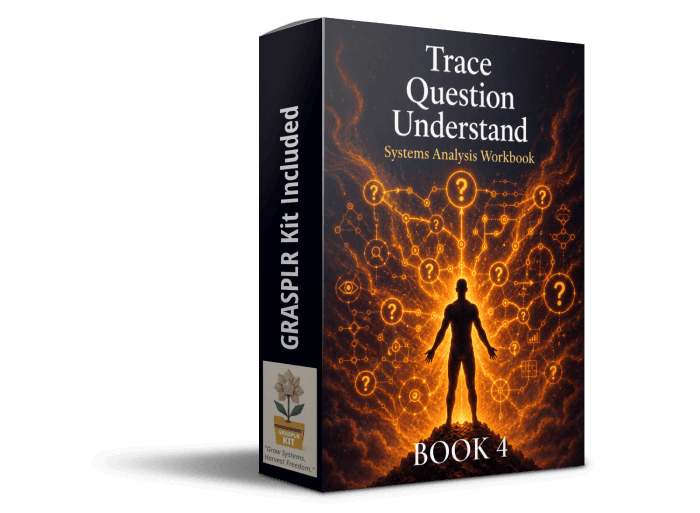
A guided workbook teaching:
• Structural analysis
• Dependency tracing
• Feedback interpretation
• Systems questioning
• Hidden relationship discovery
GRASPLR Kit Included + 20 PLR Article Pack
Free and available after purchasing your 5th Product

Apply systems literacy to:
• Business AI
• Biology
• Marketing
• Healthcare
• Logistics
• Construction
• Government
• Everyday life
GRASPLR Kit Included + 20 PLR Article Pack
Free and available after purchasing your 6th Product

A full long-term reference manual covering:
• Systems theory
• Interpretation methods
• Pattern recognition
• Diagram mastery
• Systems journaling
• Lifelong observation frameworks
GRASPLR Kit Included + 20 PLR Article Pack
Free and available after purchasing your 7th Product
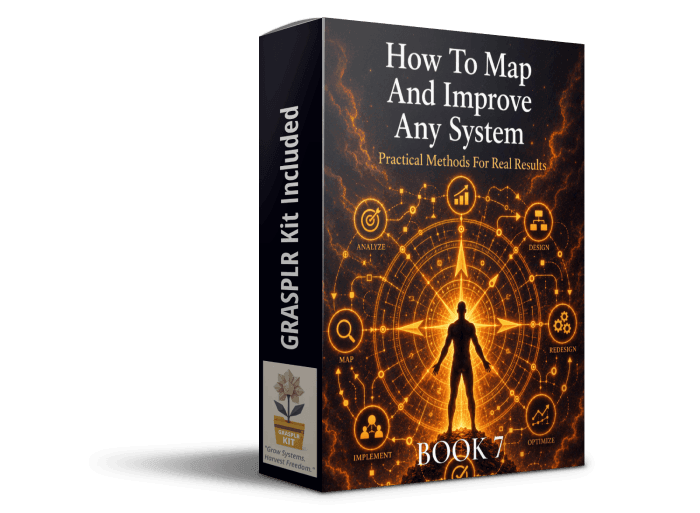
The final transition: from reading systems to redesigning them.
Learn:
• Leverage points
• Bottleneck reduction
• Workflow redesign
• Systems intervention
• Communication restructuring
• Hidden friction removal
GRASPLR Kit Included + 20 PLR Article Pack
Free and available after purchasing your 8th Product
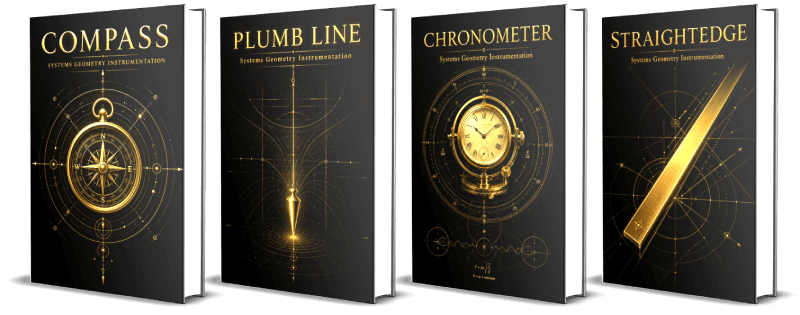
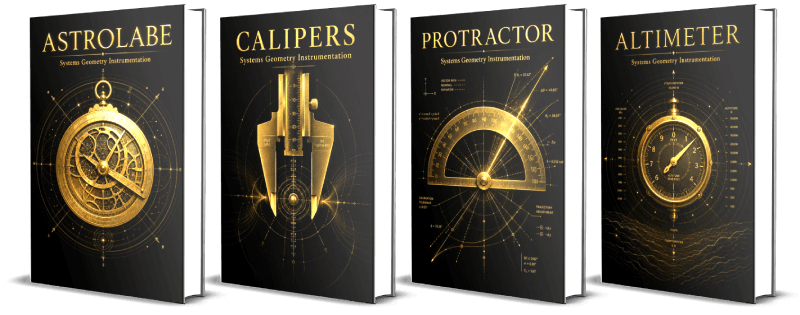
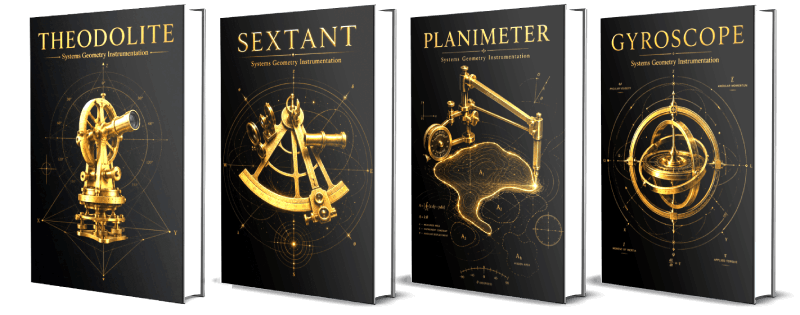
A symbolic toolkit for measuring the hidden shape of systems.
Systems Geometry Instrumentation helps readers understand structure through instruments, angles, fields, pressure points, and spatial relationships. Instead of only describing a system, this collection teaches people how to locate orientation, imbalance, distortion, distance, elevation, and alignment inside complex situations.
Learn:
• Structural measurement
• Orientation and alignment
• Pressure mapping
• Systemic distance and distortion
• Hidden geometry
• Stabilization under movement
Full set free and available after purchasing your 9th Product






A deep-reading library for recognizing what systems feel like while they are operating.
Systems Phenomenology Library explores the lived experience of systems under pressure. Each lens reveals a different systemic condition, such as blockage, weight, friction, repetition, collapse, concealment, or movement. This collection helps readers name what is happening beneath the surface before it becomes visible as failure, confusion, or breakdown.
Learn:
• System pressure recognition
• Hidden operational truth
• Friction and blockage patterns
• Structural atmosphere
• Repeating systemic signals
• Human experience inside systems
Full set free and available after purchasing your 10th Product

The foundation for understanding systems before trying to change them.
Systems Literacy introduces the core discipline of seeing systems clearly. It teaches readers how to recognize structure, relationships, patterns, constraints, feedback, pressure, and consequence. This is the starting point for anyone who wants to move beyond surface explanations and begin reading the deeper architecture behind behavior, business, communication, and change.
Learn:
• Systems awareness
• Pattern recognition
• Cause and consequence
• Feedback and constraint
• Structural thinking
• Reading complexity with clarity
Free and available after purchasing your 11th Product
This collection was designed for:
• Thinkers
• Creators
• Educators
• Analysts
• Entrepreneurs
• Overwhelmed learners
• Curious observers
• Systems-minded people
• Visual thinkers
People who feel reality has hidden layers beneath it
You do not need:
• Engineering knowledge
• Technical training
• Academic systems theory
• Mathematics expertise
You only need curiosity and observation.
Most people react to visible outcomes.
Systems thinkers learn to ask:
“What structure created this?”
That single shift changes everything.
Because once systems become visible:
• Complexity becomes readable
• Patterns become recognizable
• Behavior becomes interpretable
• Friction becomes traceable
• Leverage becomes accessible
You stop seeing isolated events.
You begin seeing structure.
It is about learning to recognize:
• Hidden flow
• Invisible instruction
• Structural influence
• Behavioural architecture
• Recurring patterns
• Unseen coordination
Because once hidden structures become visible…
reality itself begins to feel different.
BONUS ARTICLE PLR PACK 1
1 – Why Most People Never Notice the Systems Around Them
2 – The Difference Between Random Events and Organized Systems
3 – How Traffic Reveals the Logic of Systems
4 – What a Kitchen Can Teach You About Systems Thinking
5 – The Hidden Structure Behind Every Workplace
6 – Why Every Routine Is a System
7 – Inputs and Outputs in Everyday Life
8 – What Happens When One Part of a System Fails
9 – Learning to Ask “What Is This Designed to Do?”
10 – Why Systems Often Continue Even When They Stop Working
11 – Cause and Effect Thinking for Beginners
12 – The Difference Between Surface Problems and Structural Problems
13 – How Feedback Loops Shape Human Behavior
14 – Invisible Systems Inside Communication
15 – Why Small Changes Sometimes Create Big Results
16 – The Structure Hidden Inside Daily Schedules
17 – How Shopping Centers Are Designed as Systems
18 – Understanding Boundaries Inside Systems
19 – Why Some Systems Feel Stable and Others Feel Chaotic
20 – The First Step Toward Systems Literacy
BONUS ARTICLE PLR PACK 2
1 – Why Vocabulary Changes How You See Reality
2 – Understanding Inputs Without Technical Language
3 – What Outputs Reveal About a System
4 – The Meaning of Boundaries in Everyday Life
5 – Why Bottlenecks Slow Everything Down
6 – Understanding Feedback Without Complexity
7 – The Difference Between Components and Relationships
8 – What “Flow” Actually Means in a System
9 – Why Constraints Shape Every Outcome
10 – The Hidden Role of Dependencies
11 – Why Hierarchies Exist in Systems
12 – What Cycles Reveal About Repetition
13 – Understanding Signals and Responses
14 – How Processes Organize Activity
15 – Why Some Systems Adapt and Others Collapse
16 – Learning the Language of Patterns
17 – How Leverage Points Influence Entire Systems
18 – Why Terminology Reduces Confusion
19 – Translating Technical Systems Into Plain English
20 – Building Your Own Systems Glossary
BONUS ARTICLE PLR PACK 3
1 – Why Diagrams Intimidate Most People
2 – The First Question to Ask About Any Diagram
3 – How Flowcharts Tell Hidden Stories
4 – Understanding Organizational Charts Beyond Titles
5 – Why Process Maps Reveal Operational Weaknesses
6 – Reading Data Flow Diagrams Without Technical Training
7 – What Fishbone Diagrams Actually Show
8 – Understanding Feedback Loops Visually
9 – Why Arrows Matter More Than Most People Think
10 – The Difference Between Linear and Circular Systems
11 – How to Identify Starting Points in Diagrams
12 – Reading Diagrams Without Feeling Overwhelmed
13 – Why Some Diagrams Hide Important Information
14 – Understanding Layers Inside Complex Diagrams
15 – The Role of Symbols in Visual Systems
16 – How to Spot Bottlenecks in Process Diagrams
17 – Why Decision Points Matter
18 – Reading Movement Instead of Memorizing Shapes
19 – How Professionals Use Diagrams to Think
20 – Turning Diagram Reading Into a Repeatable Skill
BONUS ARTICLE PLR PACK 4
1 – Why Systems Analysis Starts With Questions
2 – The Importance of Identifying Purpose First
3 – How to Name the Components of a System
4 – Tracing Paths Through Complex Processes
5 – Why Connections Matter More Than Isolated Parts
6 – The Power of Asking “What If?”
7 – Understanding Cascading Consequences
8 – How Small Failures Become Large Problems
9 – Reading Supply Chains as Living Systems
10 – Organizational Structures and Invisible Influence
11 – Why Feedback Systems Control Stability
12 – How Analysts Identify Weak Points
13 – Recognizing Hidden Friction Inside Workflows
14 – Why Observation Beats Assumption
15 – Learning to See Structural Repetition
16 – What Stable Systems Have in Common
17 – Understanding Delays Inside Systems
18 – Why Surface Solutions Often Fail
19 – Turning Analysis Into Better Decisions
20 – Becoming More Aware of Hidden Structures
BONUS ARTICLE PLR PACK 5
1 – Why Every Industry Operates Through Systems
2 – Reading Business Systems Without an MBA
3 – How Technology Systems Organize Information
4 – Understanding Biological Systems Through Patterns
5 – The Systems Hidden Inside Daily Life
6 – Reading Healthcare as a Coordinated System
7 – Education Systems and Knowledge Flow
8 – How Logistics Systems Move the World
9 – Understanding Marketing Systems Beyond Advertising
10 – Construction Systems and Layered Coordination
11 – Al Systems Explained for Ordinary People
12 – Government Systems and Structural Complexity
13 – Social Systems and Group Behavior
14 – Why Every Field Develops Its Own Vocabulary
15 – How Professionals Learn to Read Complex Systems
16 – Recognizing Repeating Patterns Across Industries
17 – Why Some Industries Feel More Complex Than Others
18 – Understanding Human Roles Inside Systems
19 – Mapping Your Own Work Environment as a System
20 – The Universal Nature of Systems Thinking
BONUS ARTICLE PLR PACK 6
1 – Why Systems Literacy Matters More Than Ever
2 – The Foundations of Structural Thinking
3 – Inputs, Outputs, and Transformation
4 – Why Relationships Shape Outcomes
5 – Understanding Feedback at a Deeper Level
6 – How Constraints Define Possibility
7 – Pattern Recognition and Structural Awareness
8 – The Difference Between Events and Structures
9 – Reading Network Diagrams Effectively
10 – How Timelines Reveal System Evolution
11 – Understanding Matrix Structures
12 – Why Complex Systems Produce Unexpected Outcomes
13 – Comparative Systems Reading Explained
14 – Spotting Anomalies Inside Systems
15 – Why Human Systems Behave Differently Than Machines
16 – Systems Thinking in Business and Organizations
17 – Reading Al Systems Without Technical Expertise
18 – Developing Long-Term Systems Awareness
19 – The Role of Reflection in Systems Mastery
20 – Learning to Read the Hidden Structures of Reality
BONUS ARTICLE PLR PACK 7
1 – Why Most People React Instead of Redesign
2 – Mapping Systems Before Trying to Fix Them
03 – How to Define System Boundaries Clearly
04 – Finding Bottlenecks Inside Workflows
05 – Why Small Friction Creates Large Delays
06 – Understanding Structural Overload
07 – How Communication Breakdowns Damage Systems
08 – Tracing Dependencies Before Making Changes
09 – Why Leverage Points Matter
10 – Improving Systems Through Better Visibility
11 – How to Redesign a Broken Routine
12 – Mapping Team Communication More Effectively
13 – Why Feedback Distortion Creates Chaos
14 – Recognizing Structural Weakness Early
15 – Simplifying Complex Systems Without Losing Function
16 – How Flow Determines System Performance
17 – Building Better Learning Systems
18 Redesigning Systems Through Incremental Change
19 – Turning Observation Into Intervention
20 – Becoming an Active Systems Designer
SPECIAL BONUS ARTICLE PLR PACK 8
01 – What Is Systems Literacy?
02 – Why Systems Literacy Matters More Than Simple Problem Solving
03 – The Difference Between Events, Patterns, and Systems
04 – How to See the Structure Behind the Story
05 – Feedback Loops: How Systems Talk Back
06 – Constraints: The Hidden Rules That Shape Behavior
07 – Leverage Points: Where Small Changes Create Large Effects
08 – Bottlenecks: Where System Flow Gets Stuck
09 – Cause and Consequence in Complex Systems
10 – Systems Thinking vs. Linear Thinking
11 – How Systems Create Human Behavior
12 – The Role of Pressure in System Behavior
13 – The Hidden Cost of Poor System Design
14 – How to Map a System Before Changing It
15 – Why Good Intentions Fail Inside Bad Systems
16 – Reading Friction: How to Notice What Slows Progress
17 – Systemic Blind Spots: What People Miss When They Focus on Symptoms
18 – Communication as a System
19 – The Beginner’s Guide to Systems Literacy in Business
20 – From Systems Literacy to Systems Redesign
The 8 x GRASPLR Kits and 8 x 20 Article Packs (160 articles total) include full Private Label Rights (PLR),
allowing you to edit, rebrand, and use the content in your own projects.
HOME | HOW WE THINK | BLOG | SYSTEMS LANGUAGE | ABOUT | SHOP | CANTACT & FAQ’s