Intended Policy – How Deliberate Rules Keep Content Systems Aligned

Intended Policy turns those accidental patterns into deliberate operating principles: the boundaries, defaults, and decision rules that determine how a system behaves. Instead of correcting inconsistency after it appears, you define the logic that prevents it.
The goal isn’t restriction. It’s alignment: making sure individual decisions reinforce what the system was designed to achieve.
Unwritten Rules Eventually Become Uncontrolled Rules
Teams rarely begin with chaos. Drift develops gradually.
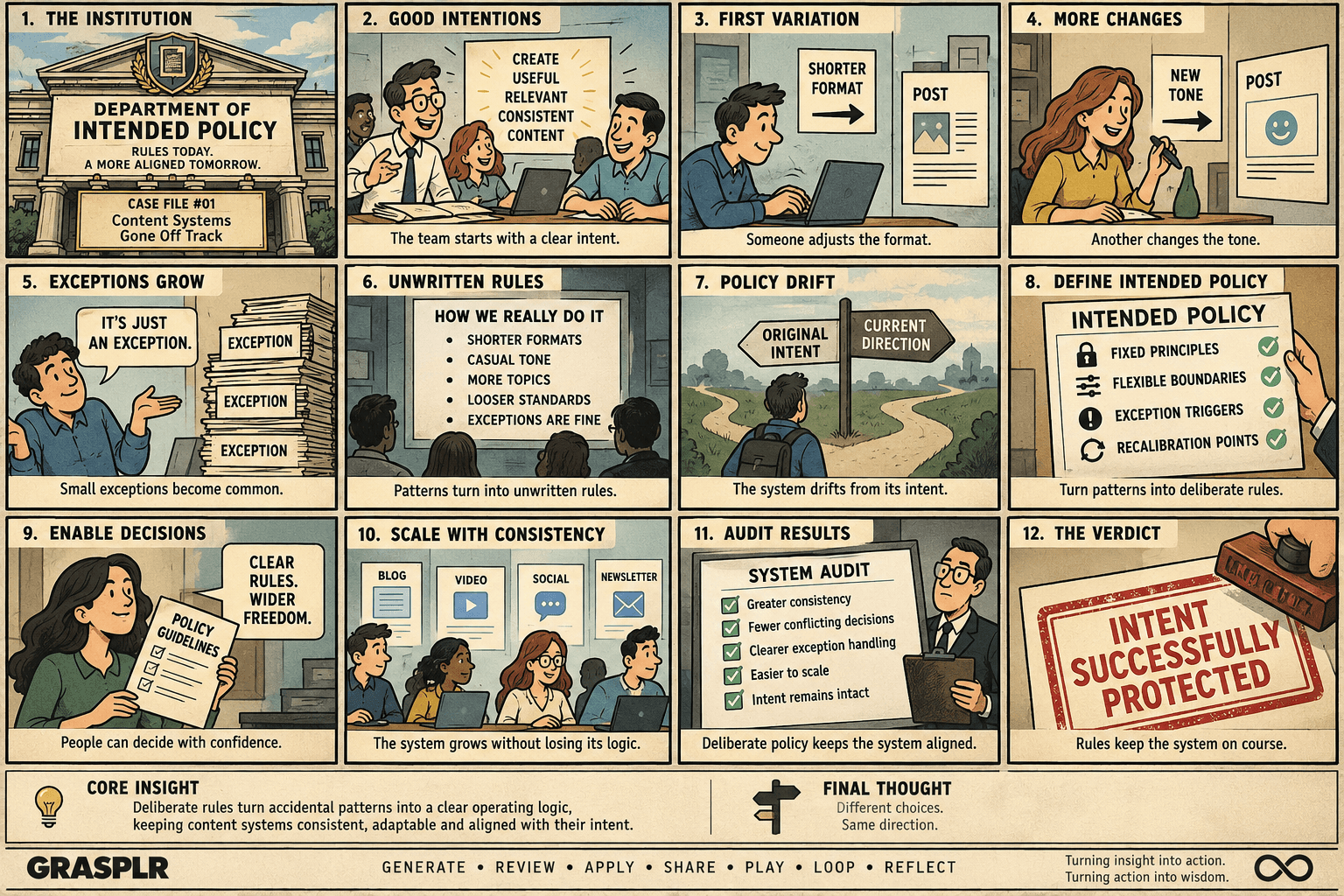
One person shortens the format. Another changes the tone. Someone else introduces a new publishing rule. Before long, exceptions become conventions.
The problem isn’t any individual decision. It’s accumulated interpretation.
Without explicit policy, people fill gaps with assumptions. Those assumptions compound until the system behaves differently from the way its creators intended.
What looks like inconsistency on the surface is often policy drift underneath.
Intended Policy as a Decision Framework
Intended Policy deliberately defines how a content system should respond to recurring choices, pressures, and exceptions.
It is the operating logic beneath the visible architecture. Strategy establishes where you want to go; policy determines how thousands of smaller decisions keep moving you there.
A strong Intended Policy defines what stays fixed, what can flex, and what requires deliberate reconsideration. That structure gives teams room to make independent decisions without routing every choice through a central authority.
The result is consistency without rigidity.
Designing Rules Around Intent
Policy starts with recurring decisions. Identify the choices the system repeatedly makes, then connect each one to the intent it is supposed to protect.
Fixed Principles: Define what should remain stable: voice, audience promise, quality thresholds, positioning, or core narrative.
Flexible Boundaries: Establish where teams can adapt formats, channels, timing, and execution without weakening the underlying intent.
Exception Triggers: Specify the conditions that justify breaking an established rule. This keeps exceptions deliberate instead of allowing them to become invisible precedents.
Recalibration Points: Review policies periodically to determine whether they still protect the original intent or merely preserve an outdated habit.
Good policy doesn’t eliminate judgment. It concentrates judgment where it matters.
Policy Protects Intent as Systems Scale
As a content system grows, individual oversight becomes a weaker way to preserve its original logic. Intended Policy makes that logic transferable.
People can change. Channels can multiply. Formats can evolve. The principles governing those decisions remain visible.
That visibility allows the system to scale without slowly becoming something else.
Consistency does not require everyone to make identical choices. It requires people making different choices from the same underlying logic.
Intended Policy gives that logic a durable form. It keeps the system adaptable while preserving the intent that gives its decisions coherence.