
Productivity is often described as doing more in less time. But in organizational settings, sustained productivity is less about speed and more about fit: the alignment between tasks, skills, and attention.
A useful observation comes from environments where output depends on care rather than force. In a well-managed garden, growth does not come from the gardener performing every action personally. It comes from arranging conditions so that each plant receives what it needs, when it needs it. Effort is distributed. Interventions are selective.
Organizations operate under similar constraints.
When employees are responsible for a wide mix of tasks—some requiring judgment and creativity, others routine and repeatable—the system begins to blur distinctions that matter. Time is fragmented. Attention is diluted. High-skill work competes with maintenance work for the same cognitive resources.
Outsourcing changes this distribution.
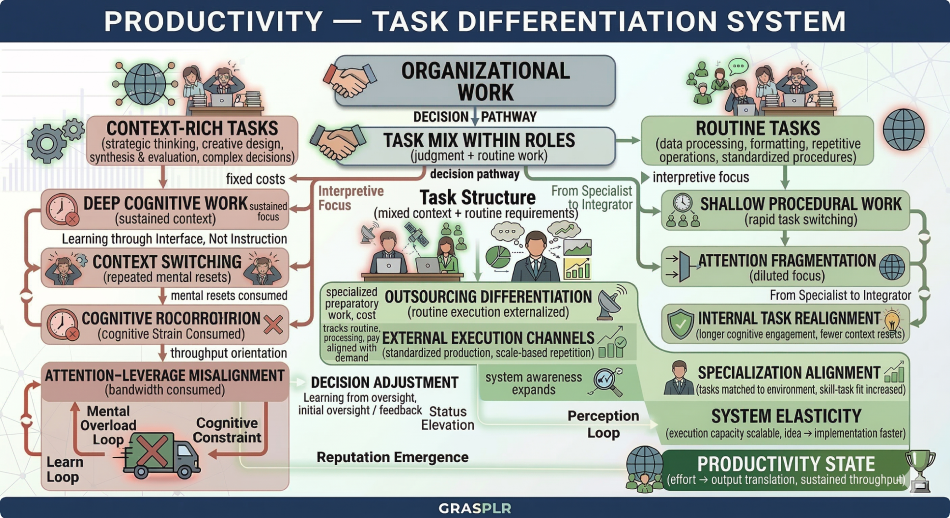
Productivity and Cognitive Load
At a structural level, productivity is limited by cognitive load. Each additional task, even a small one, imposes switching costs. When employees move repeatedly between deep, context-rich work and shallow, procedural tasks, throughput declines even if total effort increases.

The garden metaphor holds as long as it remains descriptive: growth depends less on intensity of effort and more on how care is distributed across the system.